Home › Guides › Air fryer know-how
Oil sprayer vs cooking spray in an air fryer: the gum problem
Use a pump sprayer with plain refined oil and mist the food, not the basket; the lecithin and propellant in aerosol cooking spray build a sticky film on nonstick baskets.
A pump oil sprayer filled with plain oil is the better choice for an air fryer. Aerosol cooking sprays such as PAM add soy lecithin and an anti-foaming agent to the oil and push it out under pressure, and appliance and cooking experts say that mix bakes into a sticky film that is hard to clean and shortens the life of a nonstick basket. The catch is that cheap glass pump sprayers have their own failure points, and tens of thousands of Amazon reviews spell them out. Here is what is in the can, why it gums up, which oil to put in a sprayer, and how to oil food without oiling the basket.
What is actually in a can of cooking spray
The ingredient statement on a 6 oz can of PAM Original reads: "Canola Oil, Coconut Oil, Palm Oil, Soy Lecithin (Prevents Sticking), Dimethyl Silicone (Anti-Foaming Agent)." The same label says "contents under pressure" and warns not to store the can above 120°F, which is the propellant talking (PAM Original, Walmart listing).
So a cooking spray is not just oil in a convenient form. It is oil plus an emulsifier, plus a silicone anti-foam, plus a gas to carry it out of the nozzle. None of those is a health scare at the amounts involved. The problem is what two of them do on a hot nonstick surface.
Why aerosol spray gums up a nonstick basket
Chef and culinary advisor Kevin Ashton put it plainly to Ideal Home: "Propellants, such as butane or propane, can damage the non-stick coating of your air fryer and create a sticky residue that builds up over time," and "Soy lecithin, found in many non-stick sprays, can leave a gummy residue that is difficult to clean and can degrade the air fryer basket's performance." Small-appliance expert Isabella Forgione of AO.com adds that sprays "often contain propellants and other additives that can degrade your air fryer's coating over time" (Ideal Home).
Tasting Table describes the same mechanism: lecithin "covers up the nonstick surfaces, and over time will make foods cooked on them clingy and difficult to work with" (Tasting Table).
Why the basket and not your frying pan? A pan gets a quick spray, then food, then a wash. An air fryer basket gets sprayed, then sits in 400°F moving air for 20 minutes with nothing but the spray on the bare spots. The lecithin that is not under food polymerizes into a brown varnish, and the next spray lands on top of it. After a few weeks the "nonstick" basket is a sticky basket.
Be clear about what the evidence is: expert opinion and a very large number of user reports, not a controlled lab test that measures how fast the film builds. Cosori and Ninja support pages on the subject were not reachable when we wrote this, so we are not quoting them. If your manual says anything about cooking spray, the manual wins.
What a pump sprayer gets right, and where it fails
A pump sprayer holds plain oil and uses your hand, not a propellant, to atomize it. No lecithin, no silicone, nothing to varnish. Both best-sellers on Amazon are glass bottles with a pump head and a pour spout, and both have long, honest review threads.
TrendPlain 16 oz Glass Olive Oil Sprayer sells for $9.99, rated 4.6 stars across 48,159 ratings as of October 2026. The Amazon customer summary counts about 1.1K mentions of leakage, and breakage shows up too, because it is a glass bottle that lives next to a hot appliance.
YARRAMATE 16 oz 2-in-1 Glass Olive Oil Sprayer is $8.99, rated 4.4 stars across 50,162 ratings as of October 2026. Buyers report the spray lever breaking within weeks, and leakage comes up about 1.7K times in the summary.
Those are real limits, so set expectations. Expect a mist, not an aerosol cloud. Expect to pump several times for a tray of fries. Thin oils spray better than thick or infused ones, and a nozzle crusted with old oil sputters, so rinse the head in hot water now and then. If a glass bottle on the counter bothers you, the leakage numbers above say to keep it upright and the cap on.
Which oil to put in the sprayer
Pick an oil whose smoke point sits above the temperature you cook at. Published figures from WebstaurantStore's chart: refined avocado oil 480 to 520°F, refined or "light" olive oil 390 to 479°F, canola 400 to 475°F, refined peanut 450°F, grapeseed 420°F, refined coconut 400°F, extra virgin olive oil around 320°F, and butter 302 to 350°F (WebstaurantStore).
For a basket set to 400°F, that rules out extra virgin olive oil and butter in the sprayer; both will smoke and leave their own film. Refined avocado, light olive, canola and peanut all clear 400°F with room to spare. Smoke point is about kitchen smoke and flavor, not a health ranking, and this guide does not make one. If you have a health condition that affects what fats you eat, ask your doctor.
How to oil food without oiling the basket
Isabella Forgione's advice is the simplest fix: "Try to spray your food before putting it into the air fryer. This will help to reduce the amount of spray touching your appliance and protect the non-stick coating from being damaged" (Ideal Home). In practice:
- Put the food in a bowl, mist or drizzle, and toss until it glistens. A teaspoon covers a pound of vegetables.
- Preheat the basket empty, then load the oiled food. Do not spray an empty basket.
- Halfway through, pull the basket, shake, and mist the pale side of the food, not the basket wall. The Cosori TurboBlaze 6-Qt Air Fryer has no halfway-flip reminder, so set a phone timer.
- For breaded food, mist after breading so the crumbs brown instead of staying dusty.
- Wash the basket after every use so any oil that did land on bare metal does not get a second bake.
Oiling the basket instead of the food, and spraying before preheat, both make our list of air fryer mistakes that ruin food. If the coating already feels tacky, our guide on how to clean an air fryer basket without wrecking the coating covers the soak-and-soft-sponge method; do not scrape.
Does basket material change the answer?
Yes. The gum problem is a nonstick-coating problem. A ceramic-coated basket like the Cosori's and a PTFE basket both suffer the same film. A stainless steel basket or a glass bowl will still get varnish, but you can scrub it off with a scouring pad without losing a coating, which is one of the practical differences we lay out in air fryer basket materials explained. If you are choosing a first air fryer, our first-time air fryer guide covers basket material before you ever think about oil.
Bottom line
Use a pump sprayer with plain refined oil, mist the food in a bowl, and keep aerosol cans away from a coated basket. The lecithin and propellant in a can of cooking spray are what experts and thousands of buyers blame for the sticky brown film on an aging basket. Glass sprayers leak and their levers break, so buy a cheap one and expect to replace it. Match the oil to your temperature: refined avocado, light olive, canola or peanut for 400°F cooking.
Sources
- PAM Original No-Stick Cooking Spray, 6 oz, ingredient statement (Walmart) — accessed 2026-10-09
- Ideal Home: Can you use cooking sprays in an air fryer? — accessed 2026-10-09
- Tasting Table: Why You Shouldn't Use Cooking Spray In Your Air Fryer — accessed 2026-10-09
- WebstaurantStore: Cooking Oil Smoke Points — accessed 2026-10-09
Products mentioned in this guide
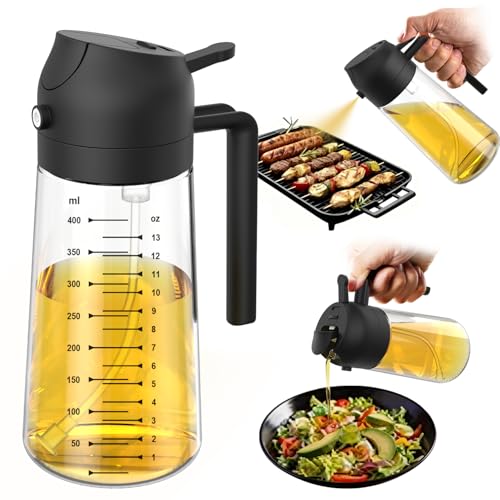
TrendPlain Glass Oil Sprayer: 48,159 reviews, 1,100 say it leaks
A $9.99 glass oil bottle that sprays and pours, with 48,159 Amazon ratings. Buyers like the even mist but report leaks and breakage, so check it as soon as it arrives.

YARRAMATE Oil Sprayer: $8.99, 50,162 reviews, one weak part
An $8.99 glass sprayer that also pours, with 50,162 Amazon ratings at 4.4 stars. It works well for many, but several buyers report the spray lever breaking within two weeks.
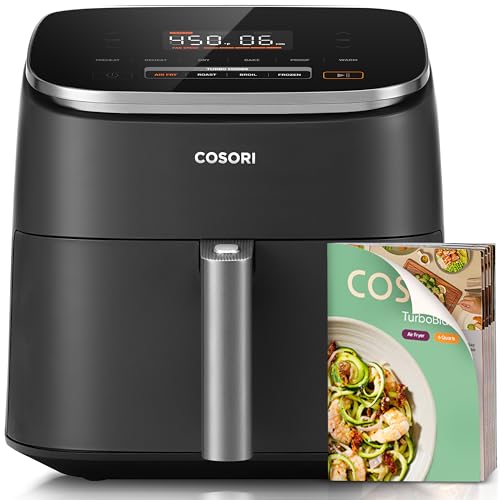
Cosori TurboBlaze 6-Qt: what 22,159 reviews agree on
The most-reviewed basket air fryer here: 4.8 stars from 22,159 Amazon ratings at $89.99. A roomy 6-quart square basket for families who want crisp results without paying for a dual-zone model.
Some links on this site are affiliate links. If you buy through them we may earn a small commission, at no extra cost to you.