PFAS-free air fryer basket: PTFE, ceramic, stainless or glass?
Short answer: PTFE is stable at air fryer heat but flakes when scratched; ceramic is fluorine-free by maker claim but fades; glass and stainless skip coatings. Only Cosori and Ninja Crispi publish a clear claim.
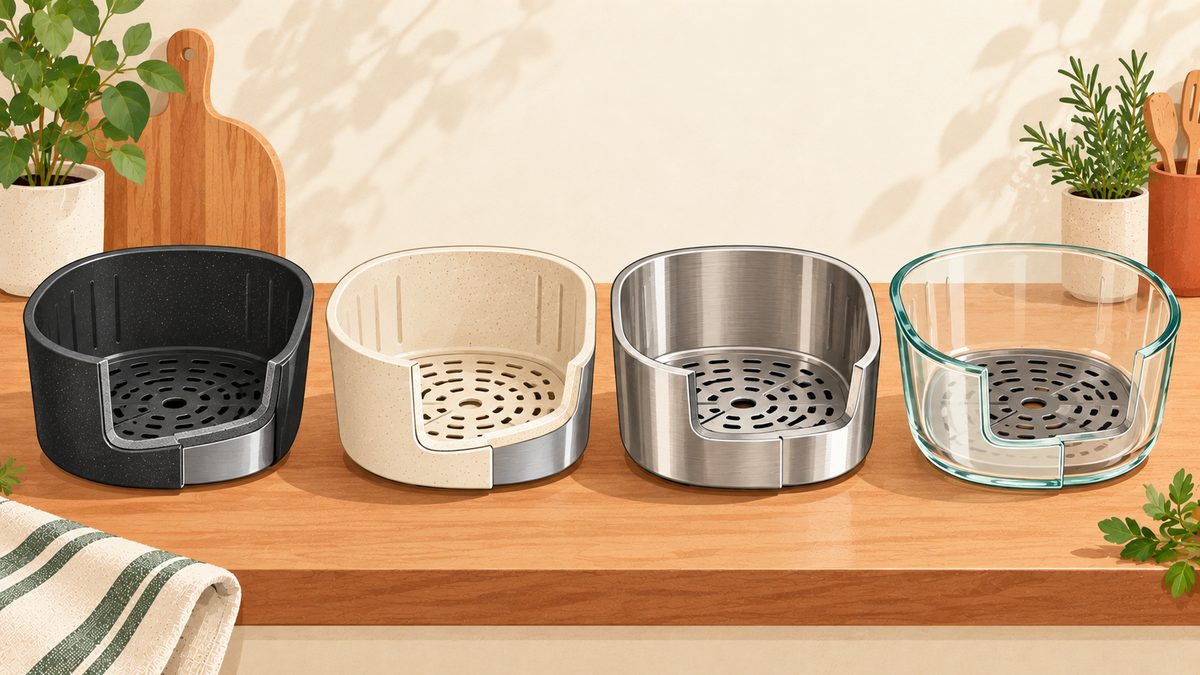
Most air fryer baskets are aluminum with one of two coatings on top: PTFE (the Teflon family of fluoropolymers) or a silica-based "ceramic" layer made by a sol-gel process. A smaller group skips coatings entirely and uses bare stainless steel or borosilicate glass. "PFAS-free" on the box is the maker's claim that the coating contains no fluorinated chemicals; it says nothing about how long the nonstick surface will last. Below is what each material is, what brands call it, how hot it can go, and how to spot it in a product listing.
1. PTFE nonstick: the default you are rarely told about
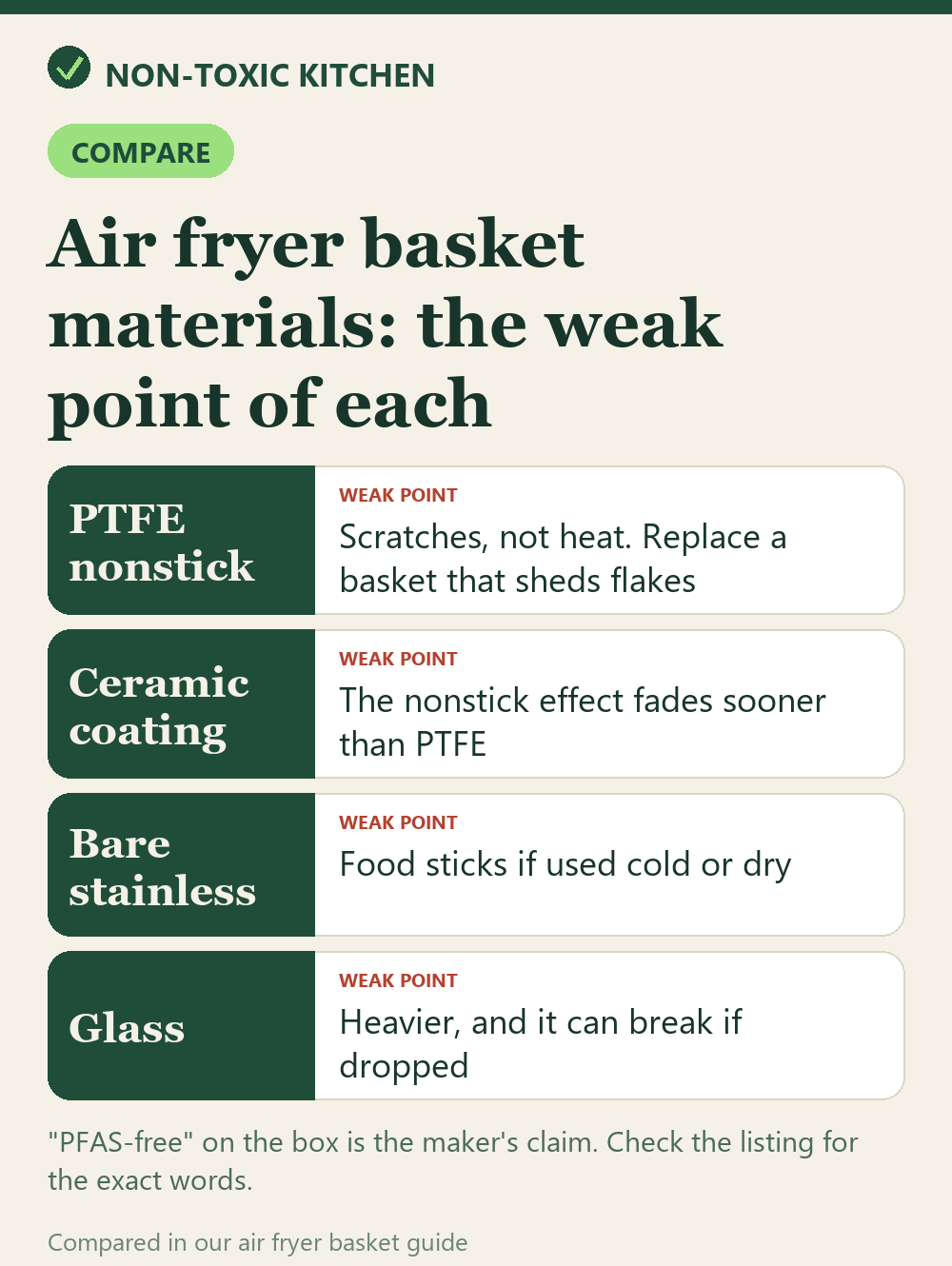
PTFE is the fluoropolymer most people know as Teflon, and it is what "nonstick" usually means when a listing gives no other detail. The FDA has authorized fluoropolymer coatings for cookware since the 1960s and says that "studies show negligible amounts of PFAS in this coating can migrate to food" when the coating is intact (FDA, Authorized Uses of PFAS in Food Contact Applications).
What makers call it: usually just "nonstick" or "non-stick coating." Some add "PFOA-free," which only means the manufacturing aid PFOA was not used; it does not mean the coating is PTFE-free. Our guide to PFAS-free vs PFOA-free labels sorts out the wording.
Heat limit: the National Capital Poison Center says PTFE "starts to break down when exposed to temperatures above about 500 °F" (Poison Control). Consumer air fryers are thermostat-controlled and top out at 400°F to 450°F on the models we cover, so the basket should not reach that range in normal use.
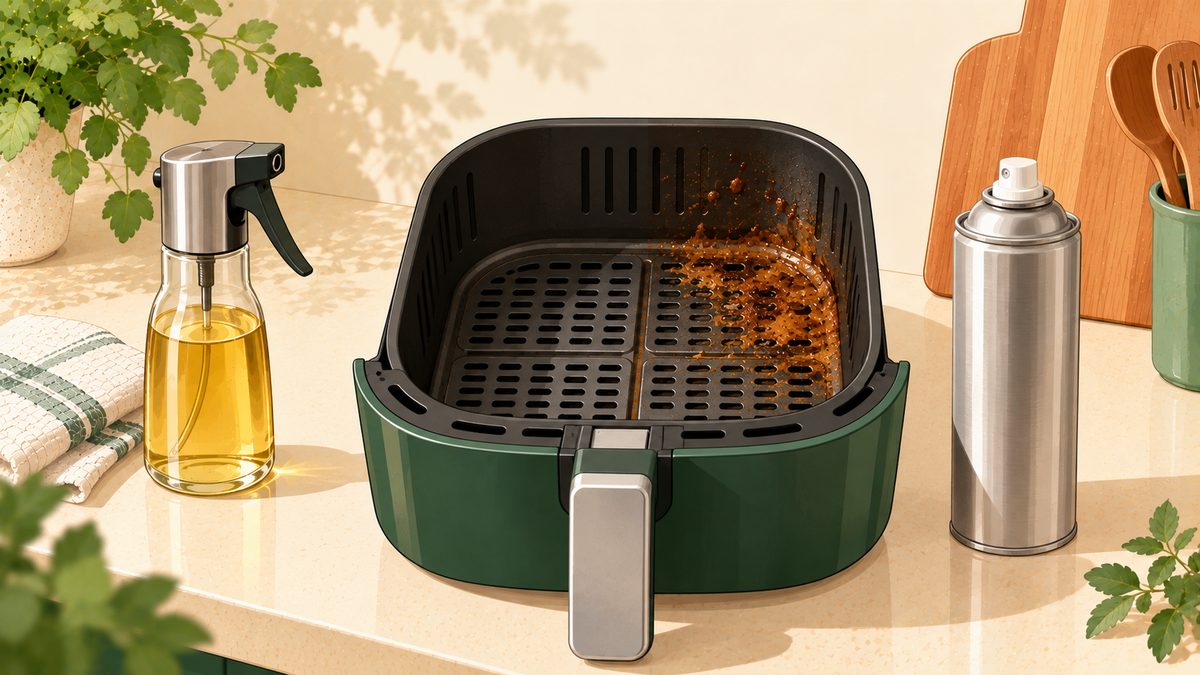
Weak point: scratches. A 2022 study in Science of the Total Environment, covered by Popular Science, estimated that a single surface crack in a PTFE coating can release around 9,100 plastic particles during cooking.
How to recognize it: the listing says "nonstick" without the words "ceramic," "PFAS-free" or "PTFE-free." The basket is usually dark gray or black with a slightly waxy sheen.
2. Ceramic sol-gel: harder, but it fades
"Ceramic" coatings are not fired clay. They are a thin glass-like film made from a silica sol plus silanes, sprayed on and cured at 120°C to 300°C. One widely cited coating patent describes a mix of silica sol (30 to 70 percent), methyltrimethoxysilane and polydimethylsiloxane, and claims a pencil hardness above 9H versus 3H to 4H for PTFE (European patent EP1835002A2). The same patent lists a small share of fluoroalkoxysilane in the top layer, which is why "ceramic" alone does not guarantee a fluorine-free surface. "PFAS-free" is the claim that matters, and it is the maker's claim to back up.
What makers call it: "ceramic coating," "PFAS-free ceramic," "PTFE-free nonstick."
Heat limit: the sol-gel cure temperature is above anything an air fryer reaches, and makers rate these baskets to the appliance's maximum (450°F on the Cosori TurboBlaze).
Weak point: the nonstick effect wears off sooner than PTFE. High heat, metal tools and the dishwasher speed that up. Our Sensarte ceramic frying pan review looks at the same trade-off on a frying pan. See our guide on ceramic nonstick safety for the cookware side of the story.
How to recognize it: the words "ceramic" or "PFAS-free" appear in the title. The coating is often lighter gray or speckled.
3. Bare stainless steel: nothing to flake, more to scrub
A stainless basket has no coating, so there is nothing to scratch off and nothing to wear out. The trade-off is release: stainless needs oil and preheating, and food sticks when it is used cold or dry (the same is true of the Cuisinart Chef's Classic stainless set on the cookware side). None of the six air fryers we review has a bare stainless basket, which tells you how niche this option still is. Our glass vs stainless vs ceramic basket comparison covers the few stainless models on the market.
4. Glass: coating-free, but handle with care
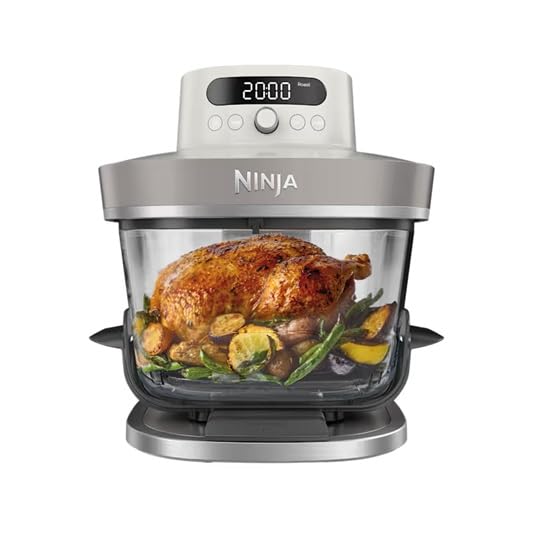
The Ninja Crispi Pro Glass replaces the basket with a borosilicate glass container and a crisper plate inside it. Ninja says the glassware is "PFAS- & PTFE-free" on cooking surfaces and "thermal shock resistant" (SharkNinja product page). The maker's own care note still tells you to "allow glass to cool gradually to room temperature before placing it in water, sink, or dishwasher" (SharkNinja Singapore). Glass is heavier, it can break if dropped, and it is the priciest model we cover.
What the makers actually publish
Exact wording from maker and Amazon pages for the four models people ask about most:
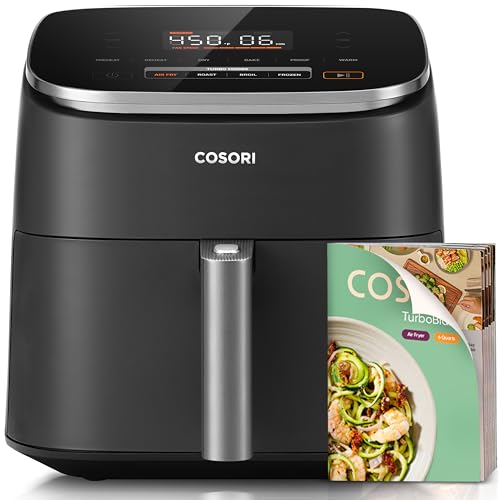
- Cosori TurboBlaze 6-Qt. The maker says: "Toss the PFAS-free ceramic-coated, nonstick basket and crisper plate into the dishwasher for hassle-free cleanup," with a 90°F to 450°F range and a 2-year limited warranty (Cosori). The Amazon title repeats "PFAS-Free Ceramic Coating" (Amazon listing).
- Ninja Air Fryer Pro AF142. The Amazon title says "Dishwasher-safe" and the bullets say "5-QT nonstick basket and crisper plate" and "BPA-free" (Amazon listing). SharkNinja's page for the sibling AF141 says only "nonstick basket and crisper plate" and "up to 400F of heat" (SharkNinja). Neither page names the coating chemistry. We could not confirm PTFE or ceramic from the maker's published pages. If PFAS-free matters to you, ask Ninja in writing or choose a model that states it.
- Ninja Crispi Pro Glass AS101LG. The maker says "PFAS- & PTFE-free," "thermal shock resistant," dishwasher safe, "up to 450°F" (SharkNinja). The Amazon bullet adds "PFAS-FREE, PTFE-FREE & BPA-FREE" borosilicate glass, marked as a manufacturer claim (Amazon listing).
- Ninja Flip SP151. SharkNinja lists an air fry basket, sheet pan, wire rack and crumb tray, and the spec line reads "Dishwasher Safe: No" (SharkNinja). The Amazon listing gives an 85°F to 450°F range (Amazon listing). We found no coating statement for the basket on either page. Unconfirmed.
The Chefman 4-Qt sits in the same bucket as the Ninja Pro: "nonstick" and "dishwasher safe" in the listing, no chemistry named.
How to read a listing in 30 seconds
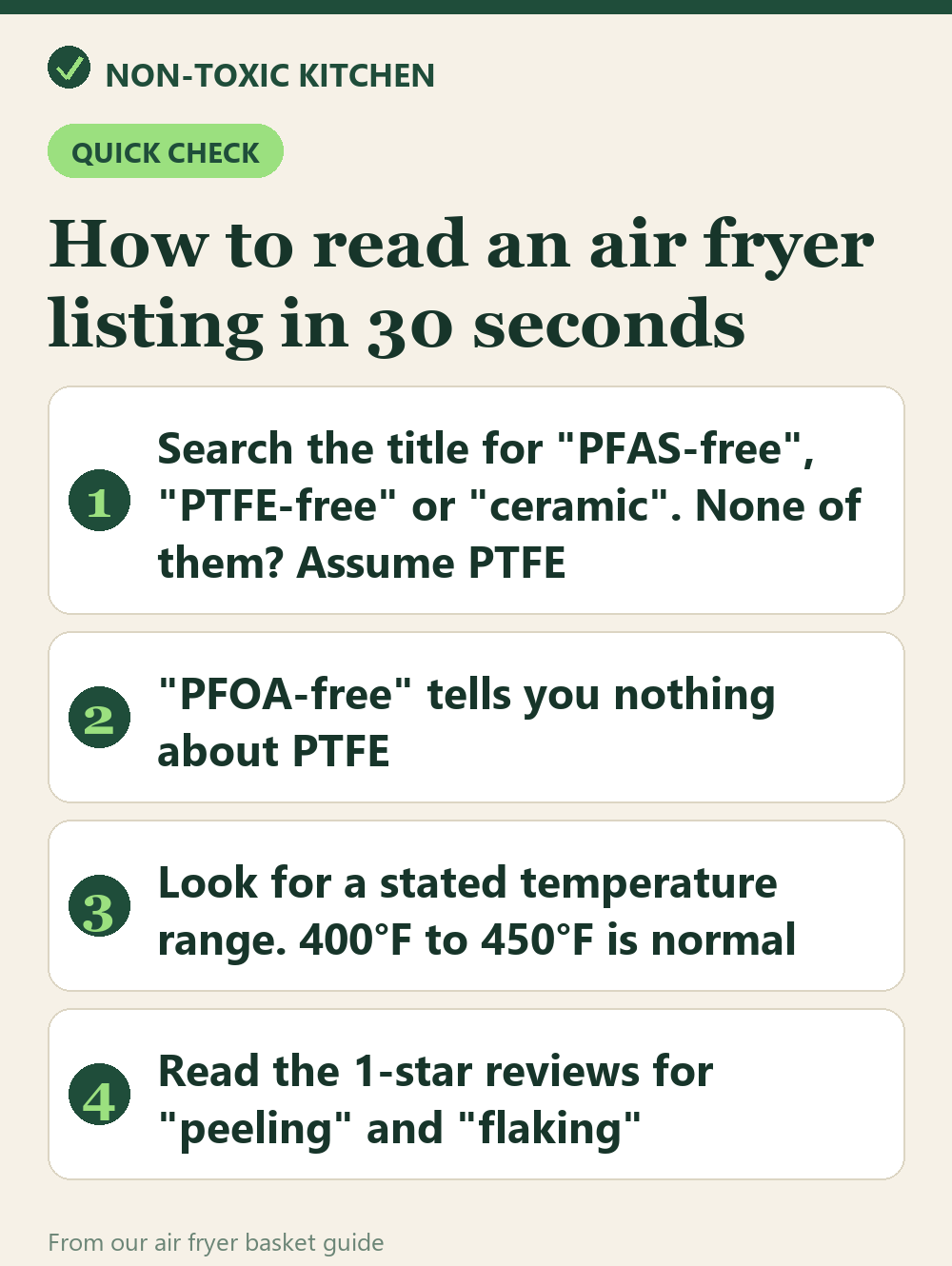
- Search the title and bullets for "PFAS-free," "PTFE-free" or "ceramic." If none appear, assume PTFE.
- Treat "PFOA-free" as neutral. It is true of nearly all cookware sold today and tells you nothing about PTFE.
- Look for a stated temperature range. 400°F to 450°F is normal; nothing in the listing should push a coating past 500°F.
- Scan the newest buyer reviews on the Amazon page for "peeling" and "flaking."
Scratched basket: keep or replace
For PTFE: Poison Control's advice is to "inspect your cookware regularly for chips and scratches and replace any damaged cookware" (Poison Control). The FDA's "negligible" migration finding applies to intact coatings; the 2022 particle study is about cracked ones. Consumer Reports adds that metal utensils, steel wool and abrasives "can scratch or chip the nonstick coating" (Consumer Reports). A hairline scuff is not an emergency; a basket shedding flakes into food is a replace-it basket. Our cleaning guide covers replacement baskets.
For ceramic: a scratch exposes aluminum and ends the nonstick in that spot, but there is no fluoropolymer to worry about. Replace when food sticks everywhere or the surface is visibly bare.
For stainless and glass: scratches are cosmetic. Replace glass only if it chips or cracks.
If you have a health condition that makes you cautious about any of these materials, ask your doctor rather than a product listing. For the bigger picture on what air fryers do and do not do to your food, read is the air fryer bad for you.
Bottom line
PTFE is the quiet default and is stable at air fryer temperatures; its problem is scratches, not heat. Ceramic sol-gel is harder and fluorine-free by the maker's claim, but its release fades sooner. Stainless and glass remove the coating question and add weight, sticking or breakage. Of the four models we checked, Cosori and Ninja Crispi publish a clear material claim; Ninja Pro and Ninja Flip do not. If this is your first air fryer, start with our first-time air fryer guide, then avoid the mistakes that ruin a basket and check whether liners are worth it.
Sources
- FDA — Authorized Uses of PFAS in Food Contact Applications — accessed 2026-10-09
- National Capital Poison Center — Teflon flu — accessed 2026-10-09
- Popular Science — coverage of the 2022 Science of the Total Environment study on Teflon particles — accessed 2026-10-09
- Google Patents — EP1835002A2, Non-stick ceramic coating composition and process — accessed 2026-10-09
- Cosori — TurboBlaze 6.0-Quart Air Fryer product page — accessed 2026-10-09
- Amazon — Cosori TurboBlaze listing — accessed 2026-10-09
- Amazon — Ninja Air Fryer Pro AF142 listing — accessed 2026-10-09
- SharkNinja — Ninja Air Fryer Pro AF141 product page — accessed 2026-10-09
- SharkNinja — Ninja Crispi Pro Glass AS101LG product page — accessed 2026-10-09
- SharkNinja Singapore — Ninja Crispi Pro AS101 care notes — accessed 2026-10-09
- Amazon — Ninja Crispi Pro Glass listing — accessed 2026-10-09
- SharkNinja — Ninja Flip SP151 product page — accessed 2026-10-09
- Amazon — Ninja Flip SP151 listing — accessed 2026-10-09
- Consumer Reports — How to Clean an Air Fryer — accessed 2026-10-09
Products mentioned in this guide
Cosori TurboBlaze 6-Qt: is the ceramic coating worth it?
Ninja Crispi Pro Glass Air Fryer: is glass worth it?

Ninja Air Fryer Pro 5-Qt: worth more than the Cosori?
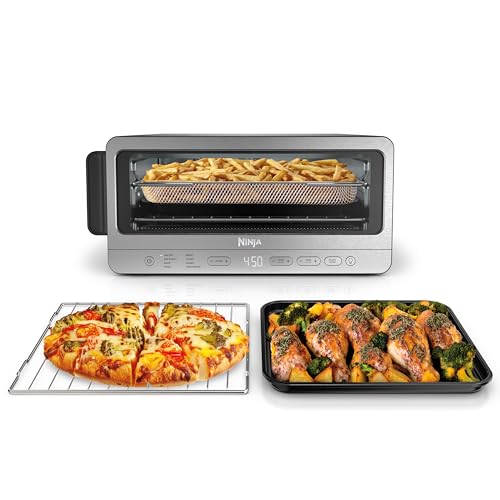
Ninja Flip SP151: does a flip-up oven cook evenly?

Chefman 4-Qt Compact Air Fryer: enough for two people?
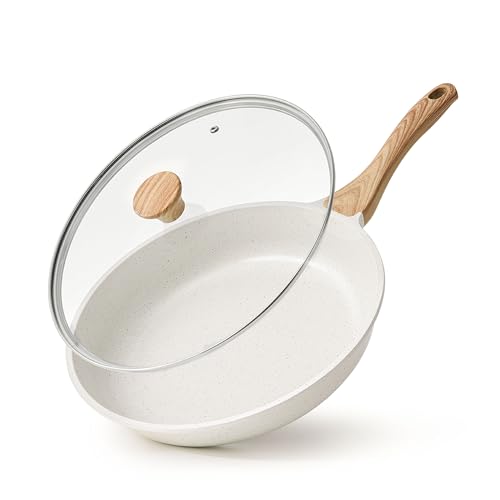
Sensarte Ceramic Frying Pan: is ceramic nonstick worth it?
As an Amazon Associate I earn from qualifying purchases. Some links on this site are affiliate links: if you buy through them we may earn a small commission, at no extra cost to you.