Home › Guides › Cookware materials, explained
PFAS-free vs PFOA-free vs non-toxic: what cookware labels mean
PFAS-free rules out the whole chemical family including PTFE. PFOA-free rules out one chemical U.S. makers stopped producing by 2015. Non-toxic has no legal definition, so it tells you nothing.
"PFAS-free" means the maker says no per- and polyfluoroalkyl substances were added, and that includes PTFE, the polymer in classic nonstick. "PFOA-free" only rules out one chemical that U.S. manufacturers agreed to stop making by 2015, so a PFOA-free pan can still be coated in PTFE. "Non-toxic" has no legal definition at all. Of the three labels, only the first one tells you something about the coating, and even that one needs a lab report behind it.
PFAS is a family, not a chemical
The EPA describes PFAS as "thousands of PFAS chemicals" used across consumer, commercial and industrial products, and says that number is part of why risk assessment is hard (EPA, PFAS Explained). The definition most regulators now lean on comes from the OECD in 2021: a PFAS is any fluorinated substance with at least one fully fluorinated methyl or methylene carbon atom. Under that wording, the EPA's DSSTox database lists 14,735 unique PFAS, and fluoropolymers such as PTFE are counted as members of the family (Wikipedia, Per- and polyfluoroalkyl substances).
That last point is the one that matters at the cookware aisle. If PTFE is a PFAS, then a PTFE pan cannot honestly be called PFAS-free, no matter what else is or is not in it. Our pillar on non-toxic cookware materials sorts every common pan by what it is made of, which is the only shortcut around the label problem.
PFOA-free: a promise about 2015
PFOA (perfluorooctanoic acid) was the processing aid used for decades to make PTFE. In January 2006 the EPA launched the PFOA Stewardship Program, in which eight companies, DuPont and 3M/Dyneon among them, committed to cut PFOA emissions and product content by 95 percent by 2010 and to work toward eliminating it by 2015. The EPA states that domestic production and import of PFOA has been phased out in the United States by those companies (EPA, 2010/2015 PFOA Stewardship Program). The American Cancer Society adds that PFOA and closely related chemicals such as PFOS are no longer made in the U.S., though they may still be made elsewhere and arrive in imported goods (American Cancer Society).
So "PFOA-free" is close to the industry default, not a premium feature. It also does not guarantee a clean coating. In October 2022 Consumer Reports had a lab test three nonstick pans for 96 PFAS compounds. The two ceramic pans, an Our Place Always Pan and a Red Copper pan, showed none. The PTFE-coated Swiss Diamond pan, sold with a PFOA-free claim, averaged 4 parts per billion of PFOA in the coating, with total PFAS of 639 ppb in one sample and 703 ppb in another (Consumer Reports). The full details are in our cookware lab test tracker.
PTFE is a PFAS, and also a polymer
Both sides of this argument are worth hearing. PTFE is a solid fluoropolymer. It begins to deteriorate at about 260 C (500 F) and decomposes above 350 C (662 F); the breakdown products can cause flu-like symptoms known as polymer fume fever, which usually clear within a day or two of fresh air (Wikipedia, PTFE). Below those temperatures it is widely regarded as inert, which is why the cookware industry's trade group, the Cookware Sustainability Alliance, argues in court that fluoropolymer coatings are fundamentally different compounds from the small PFAS molecules that pollute water, do not dissolve or bioaccumulate in normal use, and are FDA-approved (Homepage News).
Minnesota's pollution control agency takes the other view. Its guidance says Teflon is the brand name for one member of the PFAS family, PTFE, and that "as a PFAS" it is prohibited from use in cookware sold in the state (Minnesota Pollution Control Agency). The scratched-pan and overheating questions get their own treatment in Is Teflon safe in 2026?. If you have a health condition, ask your doctor rather than a label.
"Non-toxic" and "ceramic" have no legal definition
The Federal Trade Commission's Green Guides do not define non-toxic. Section 260.10 only says a marketer who makes the claim must hold competent and reliable scientific evidence that the product is non-toxic for humans and for the environment, or clearly qualify the claim (16 CFR 260.10, Cornell LII). That is a substantiation rule, not a standard. It does not name a test, a threshold or a chemical list.
The Guardian reported in June 2025 that "no legal definition for 'nontoxic' or 'ceramic' exists" in cookware marketing. The bestselling "ceramic" pans from Our Place, Caraway and GreenPan use a sol-gel coating, a silica-and-metal mixture sprayed onto aluminum, which the article says can degrade above 260 C, and Washington State has ordered those makers to disclose their nonstick ingredients because regulators do not know what replaced PTFE (The Guardian, via Yahoo News). The gap between "ceramic" and actual fired clay is covered in Is ceramic nonstick cookware safe?.
The cost of a loose word showed up in 2025, when HexClad settled a class action for $2.5 million over "non-toxic" and PFAS-free marketing on pans that contained PTFE, without admitting wrongdoing (Chowhound). We walk through that case in Is HexClad non-toxic?.
State laws are drawing the line for you
Minnesota moved first. Amara's Law, named for Amara Strande, who campaigned for the bill while fighting liver cancer, banned intentionally added PFAS in 11 product categories, cookware included, from January 1, 2025, with a broader ban on non-essential uses scheduled for 2032 (Vice). The cookware industry sued in federal court in January 2025, and the case was still pending when that report was filed (Homepage News).
Other states follow in a line. Colorado's ban takes effect January 1, 2026 under SB24-81, after labeling rules that began in 2024. Vermont's S 25 bans cookware with intentionally added PFAS from January 1, 2026. Maine's date is also January 1, 2026. Rhode Island's SB 2152 bans it from January 1, 2027. California has required labeling since January 1, 2023 under AB 1200 (BCLP Law). Connecticut is a two-step: labeling and notification from January 1, 2026, then a sales ban on January 1, 2028 (Keller and Heckman, Packaging Law). One caution: the BCLP summary lists Connecticut's effective date simply as 2026, so check the statute if you sell there.
How to read a cookware label in 5 steps
- Find the coating word. If the box says "nonstick" and never names the material, assume PTFE. Makers who have switched to sol-gel almost always say "ceramic."
- Treat PFOA-free as the baseline. It has been close to universal since 2015 and says nothing about PTFE.
- If it says PFAS-free, look for a third-party report with a lab name, a date and a compound count. Our lab test tracker lists the ones that are public.
- If it says non-toxic or ceramic, ask what the coating is actually made of. Neither word is regulated, and sol-gel coatings are not fired clay.
- Remember that bare materials need no label at all. The Cuisinart Chef's Classic Stainless 11-Piece Set ($113.15, 4.3 stars, 9,820 ratings on Amazon as of October 2026) and the Lodge 10.25-Inch Cast Iron Skillet ($22.91, 4.6 stars, 87,490 ratings) have no coating to argue about.
Two examples from our review list. The Carote 20-Piece Titanium Nonstick Cookware Set ($99.99, 4.6 stars, 591 ratings on Amazon as of October 2026) is sold on the word "titanium," but that describes a coating, not the pan body, and it is the maker's claim. The Cosori TurboBlaze 6-Qt Air Fryer ($89.99, 4.8 stars, 22,159 ratings) is listed with a ceramic-coated basket; Minnesota's definition of cookware reaches air fryers with nonstick parts, which is why basket material is now a buying question (Keller and Heckman, Packaging Law).
Bottom line
PFAS-free is the only one of the three labels with real content, and it is only as good as the lab report behind it. PFOA-free describes a chemical the U.S. industry retired a decade ago. Non-toxic and ceramic are unregulated words, which is why one brand paid $2.5 million over them. State bans starting in 2025 and 2026 will push PTFE off many shelves regardless of what the box says. Until then, the safest way to read a label is to skip it and read the material.
Sources
- EPA, PFAS Explained — accessed 2026-10-09
- Wikipedia, Per- and polyfluoroalkyl substances (OECD 2021 definition) — accessed 2026-10-09
- EPA, 2010/2015 PFOA Stewardship Program — accessed 2026-10-09
- American Cancer Society, Teflon and PFOA — accessed 2026-10-09
- Consumer Reports, You Can't Always Trust Claims on Non-Toxic Cookware — accessed 2026-10-09
- Wikipedia, Polytetrafluoroethylene — accessed 2026-10-09
- Homepage News, Cookware group sues Minnesota — accessed 2026-10-09
- Minnesota Pollution Control Agency, 2025 PFAS prohibitions — accessed 2026-10-09
- 16 CFR 260.10 Non-toxic claims, Cornell LII — accessed 2026-10-09
- The Guardian via Yahoo News, Toxic truth? The cookware craze redefining 'ceramic' and 'nontoxic' — accessed 2026-10-09
- Chowhound, HexClad settlement — accessed 2026-10-09
- Vice, Minnesota PFAS ban (Amara's Law) — accessed 2026-10-09
- BCLP Law, PFAS in cookware: state-by-state regulations — accessed 2026-10-09
- Keller and Heckman Packaging Law, Several states expand PFAS bans to include cookware — accessed 2026-10-09
- Keller and Heckman Packaging Law, Minnesota defines cookware covered by PFAS ban — accessed 2026-10-09
Products mentioned in this guide

Cuisinart Chef's Classic Stainless Set: no coating, some staining
A $113.15 stainless steel set with aluminum-encapsulated bases and glass lids, no nonstick coating. Buyers like the look and even heat, but some report staining and food sticking.
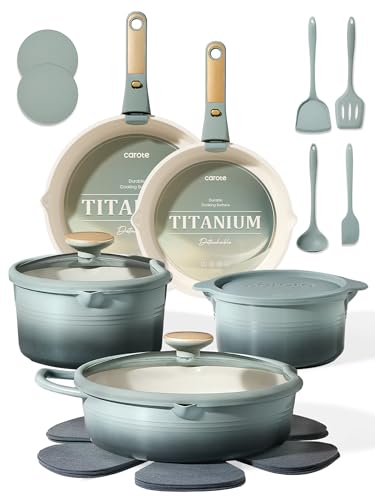
Carote 20-Piece Titanium Set: is "titanium" just a coating?
A $99.99 detachable-handle set that stacks to save space. Only 591 Amazon ratings so far, and buyers disagree on whether the coating scratches.
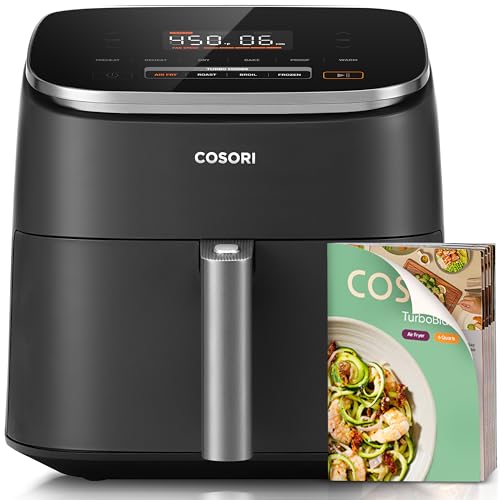
Cosori TurboBlaze 6-Qt: what 22,159 reviews agree on
The most-reviewed basket air fryer here: 4.8 stars from 22,159 Amazon ratings at $89.99. A roomy 6-quart square basket for families who want crisp results without paying for a dual-zone model.
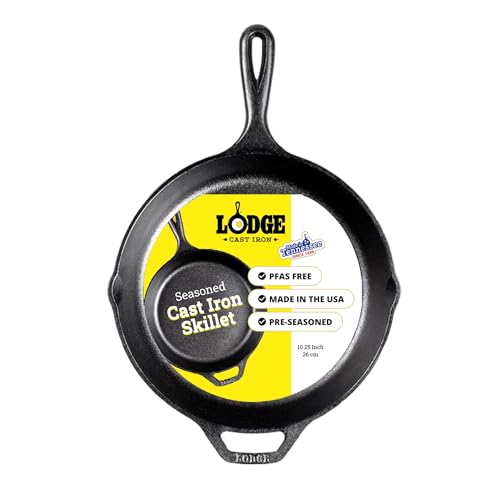
Lodge 10.25-Inch Cast Iron Skillet: 87,490 reviews, rust explained
The classic American cast iron skillet at about $22.91 with 87,490 Amazon ratings. Tough and versatile, but some buyers report rust after first use and food sticking.
Some links on this site are affiliate links. If you buy through them we may earn a small commission, at no extra cost to you.