Home › Guides › Cookware materials, explained
Is Teflon safe in 2026? PTFE, PFOA and the scratched-pan question
PTFE is stable at normal cooking heat and PFOA left US production by 2015; the real risks are overheating an empty pan and cooking on a flaking coating.
Teflon (PTFE) cookware is stable at normal cooking temperatures, and PFOA, the manufacturing chemical behind the original scare, was phased out of US production by 2015. The two real-world problems are heat and wear: an empty pan on high heat can pass 500°F in minutes and the coating then breaks down into fumes that cause flu-like "polymer fume fever" in people and can kill pet birds, and a flaking coating sheds particles whose health effect nobody has measured. Used on low to medium heat with food in it and replaced when it scratches, a PTFE pan has no documented harm.
What PTFE is and what PFOA was
PTFE is polytetrafluoroethylene, the slick fluoropolymer sprayed and baked onto aluminum pans. Teflon is one brand name for it. Consumer Reports describes PTFE as "one member of a group of chemicals called PFAS," the family often called forever chemicals.
PFOA is a different chemical. It was a processing aid used to make PTFE, not the coating itself. The American Cancer Society notes that the International Agency for Research on Cancer now classifies PFOA as "carcinogenic to humans (Group 1)" and that PFOA and close relatives "are now no longer made in the US." That phase-out came through the EPA's 2010/2015 PFOA Stewardship Program, in which eight companies including DuPont and 3M agreed to cut PFOA 95% by 2010 and work to eliminate it by 2015. The EPA adds a caveat worth reading: companies outside the program may still produce or import PFOA.
So "PFOA-free" on a pan sold in the US today is close to a given. It says nothing about the rest of the PFAS family. Our guide on PFAS-free vs PFOA-free vs "non-toxic" labels sorts out the wording.
GenX: what replaced PFOA, and why that is still argued
Makers did not stop using processing aids; they switched. The EPA describes GenX chemicals (HFPO dimer acid and its salt) as "a processing aid technology used to make high-performance fluoropolymers without the use of perfluorooctanoic acid (PFOA)," and finalized a human health toxicity assessment for GenX in October 2021 with oral reference doses for chronic and subchronic exposure. On its PFAS overview page the EPA states plainly that "PFOA and PFOS have been replaced in the United States with other PFAS in recent years," and lists the effects linked to certain PFAS exposure levels: reproductive and developmental effects, increased risk of some cancers, reduced immune response, and higher cholesterol.
That is the fair summary. The coating on your pan is PTFE, stable at cooking heat. The manufacturing chain behind it uses PFAS chemistry the EPA is still assessing. Both are true at once. Which brands have published third-party tests is in our cookware lab test tracker.
The temperature question: when PTFE breaks down
Numbers from the sources we could open, lowest to highest:
- Degradation begins above 280°C (536°F), per Cornell University's College of Veterinary Medicine, "releasing toxic pyrolysis byproducts."
- Pyrolysis runs from roughly 315 to 375°C (600–707°F), per a 2012 case report in BMJ Case Reports.
- The widely quoted consumer threshold is 500°F (260°C), the figure used in physician-facing coverage of "Teflon flu".
The practical point is how fast an empty pan gets there. A 2003 Science News investigation reported an empty nonstick pan reaching 400°F in two minutes and 730°F in five on a household burner, while an inhalation toxicologist quoted in the same piece said that with food in it, a pan will never reach temperatures that produce toxic PTFE gases. DuPont's position at the time: even at 500°F the cookware "won't release material harmful to human health."
The rule that follows: never preheat a PTFE pan empty, and keep burner settings at medium or below.
Polymer fume fever ("Teflon flu")
Polymer fume fever is the illness caused by inhaling PTFE breakdown products. The BMJ Case Reports paper describes a healthy 29-year-old who left a PTFE pan on the burner for about five hours while napping, then developed fever, shortness of breath and a dry cough. His symptoms "dramatically diminished" the next day and were gone by the third day.
It is rare and usually self-limiting, but not trivial. The physician network Docquity reported that in 2023 more than 250 Americans went to the hospital with it, the highest count since 2000. Its prevention list is short: don't overheat, don't exceed 500°F, add fat before heating. If you develop flu-like symptoms within hours of a burned pan, tell your doctor what happened; the symptoms look like a virus.
Pet birds
Cornell explains that the particles and acidic gases from overheated PTFE cause "respiratory distress, neurological signs and death," that birds are often "found dead with no premonitory signs," that there is no reliable test, and that prevention "relies on awareness of this toxic agent and avoidance in using PTFE products with birds." Science News recounts a 1975 case of five cockatiels killed by one overheated pan. Consumer Reports says the same: overheated PTFE fumes "are deadly to small birds and may be harmful to humans as well." If you keep a parrot, cockatiel or budgie, uncoated cookware is the straightforward choice.
The scratched pan: what the sources actually say
Two separate issues hide inside this question.
Swallowing flakes. Consumer Reports' position, in a January 2026 segment summarized by Arizona's Family, is that you are "unlikely to be exposed to significant levels of PFAS if your pans are in good condition, which means no deep scratches or chips," and that worn cookware is a reason to replace. In its 2022 test article CR warned that "long-used pans with scratched coatings may not be as safe as pans in pristine condition" and told readers not to scrape PTFE with metal utensils or steel wool. We found no published study showing harm from swallowed PTFE flakes, and none clearing it.
Particle counts. A 2022 study in Science of The Total Environment from Flinders and Newcastle universities (Flinders news release) used Raman imaging to estimate about 9,100 plastic particles released from a single surface crack and 2.3 million micro- and nanoplastics from a broken coating. The authors did not claim a health effect; Dr. Cheng Fang said these particles "might be a health concern so needs investigating," and Professor Youhong Tang called for risk assessment. Our guide to microplastics in the kitchen puts that number next to the other sources.
The honest reading: a lightly scuffed pan is not an emergency, a flaking pan is a pan you stop using, and nobody has the data to draw the line between them for you.
When to replace, and what to replace it with
Replace a PTFE pan when the coating flakes, when there are deep scratches or chips, or when food starts sticking across the whole surface. The signs by coating type are in when to replace a nonstick pan.
In our review table, the Sensarte 9.5-Inch Swiss Granite Frying Pan and the Carote 8-Inch Granite Frying Pan are the two most-reviewed nonstick skillets, at 35,410 and 36,171 Amazon ratings as of October 2026; the top complaint for both is handles breaking within months, not coating safety. The Carote 10-Inch Granite Pan with Glass Lid draws reports of staining after first use and wear at about eight months. "Granite" describes the look; the listings do not state the coating chemistry, so ask the maker whether it is PTFE-based.
If you would rather skip the question, the Lodge 10.25-Inch Cast Iron Skillet has no coating to scratch or overheat, costs about $23 on Amazon as of October 2026, and becomes nonstick with seasoning. Ceramic sol-gel is the other PTFE-free route; its trade-offs are in is ceramic nonstick cookware safe, and all six materials sit side by side in our guide to non-toxic cookware materials.
Bottom line
PTFE itself is not the villain of the Teflon story; PFOA was, and it is out of US production. The remaining risks are things you control: heat and wear. Keep the burner at medium, never heat the pan empty, keep birds out of the kitchen, and retire the pan the day it flakes. If you have a respiratory condition or any health concern, ask your doctor. And if you want to stop thinking about it, buy a pan with nothing on it.
Sources
- Consumer Reports — You can't always trust claims on "non-toxic" cookware — accessed 2026-10-09
- American Cancer Society — PFAS (Teflon and PFOA) — accessed 2026-10-09
- EPA — Fact sheet: 2010/2015 PFOA Stewardship Program — accessed 2026-10-09
- EPA — Human health toxicity assessments for GenX chemicals — accessed 2026-10-09
- EPA — Our current understanding of the human health and environmental risks of PFAS — accessed 2026-10-09
- Cornell University College of Veterinary Medicine — PTFE (Teflon) toxicosis in ducks — accessed 2026-10-09
- BMJ Case Reports 2012 — Polymer fume fever (PMC4544973) — accessed 2026-10-09
- Docquity — Teflon flu on the rise: what doctors need to know about polymer fume fever — accessed 2026-10-09
- Science News — Sticky situation: nonstick surfaces can turn toxic at high heat — accessed 2026-10-09
- Arizona's Family — This is the trouble with nonstick pans, according to Consumer Reports — accessed 2026-10-09
- Flinders University — Not-so-tough Teflon — accessed 2026-10-09
Products mentioned in this guide
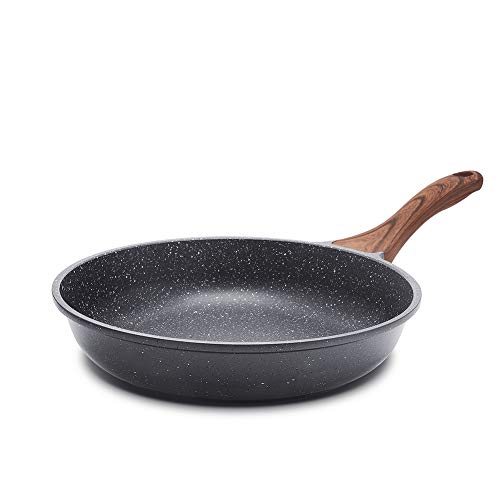
Sensarte 9.5-Inch Granite Pan: what 35,410 reviews say
At $17.99 with 35,410 Amazon ratings, this is one of the most-reviewed budget nonstick pans. Great for eggs, but some buyers report the handle breaking and mixed durability.
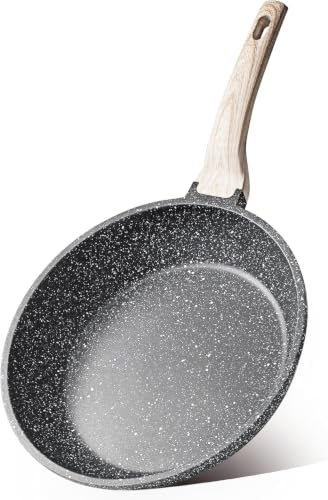
CAROTE 8-Inch Granite Pan: 36,171 reviews, 663 on durability
A small $17.99 nonstick skillet with 36,171 ratings on Amazon. Buyers love the nonstick surface and size for one or two people, but some report the handle breaking.

Carote 10-Inch Granite Pan with Lid: why it stains
A $29.99 granite-style nonstick skillet with a lid and 7,087 Amazon ratings. Fine for casual cooks on a budget, but buyers flag staining and mixed durability.
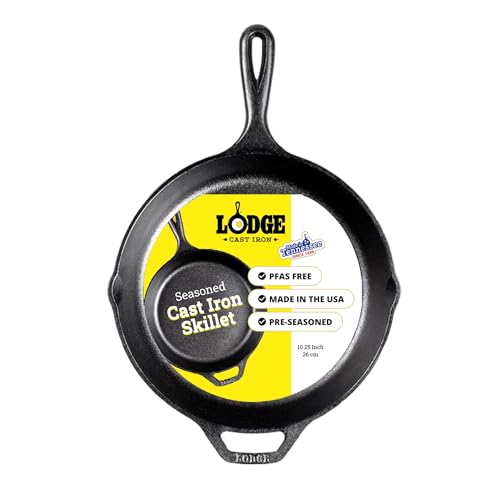
Lodge 10.25-Inch Cast Iron Skillet: 87,490 reviews, rust explained
The classic American cast iron skillet at about $22.91 with 87,490 Amazon ratings. Tough and versatile, but some buyers report rust after first use and food sticking.
Some links on this site are affiliate links. If you buy through them we may earn a small commission, at no extra cost to you.