Home › Guides › Buying guides
When to replace nonstick pans: 5 signs, by coating type
Replace any nonstick pan at the first chip, flake or deep scratch; replace a ceramic pan when it sticks or stays tacky. Swallowed PTFE flakes likely pass through, per the sources.
Replace a nonstick pan the day you see a chip, a flake or a deep scratch in the coating; that is Consumer Reports' rule for every coating type. Short of visible damage, replace it when food sticks at medium heat with a little oil, when the base has warped, or when a ceramic pan stays stained and tacky no matter how it is cleaned. PTFE and ceramic pans fail in different ways, so the signs differ too.
Sign 1: chips, flakes or peeling (PTFE and ceramic)
This is the only sign that is not a judgment call. Breann Chai, who leads cookware testing at Consumer Reports, says: "If the nonstick pan has any chips or scratches, it should be thrown away," because the coating "could be flaking off into any food being cooked in the pan," per CR's guide to making a nonstick pan last. Healthline gives the same advice for Teflon: replace it when the coating shows "excessive scratches, peeling, flaking, and chipping."
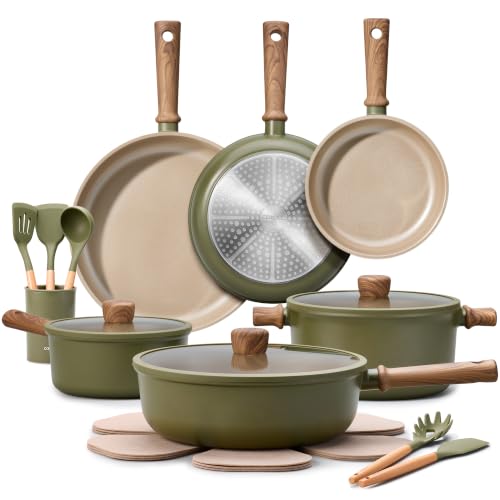
On ceramic pans, peeling is the version to watch. Amazon buyers of the Carote 21-Piece Ceramic Cookware Set mention coating peeling in 231 durability-related reviews as of October 2026, and the Sensarte 13-Piece Ceramic Set draws reports of chipping handles.
Sign 2: deep scratches from metal utensils (mostly PTFE)
Surface scuffs are a warning; a scratch that shows gray metal underneath is a stop. CR's 2026 advice, syndicated by Action News 5, is that you are "unlikely to be exposed to significant levels of PFAS if your pans are in good condition," and that "deep scratches or chips" are what move a pan out of that category. Poison Control adds that a damaged nonstick surface is a reason to replace the pan rather than keep using it.
Ceramic coatings scratch too, but they more often fail by going dull than by gouging. How to make a ceramic nonstick pan last longer has the utensil and heat rules that prevent both.
Sign 3: food sticks at medium heat with oil (ceramic first, then PTFE)
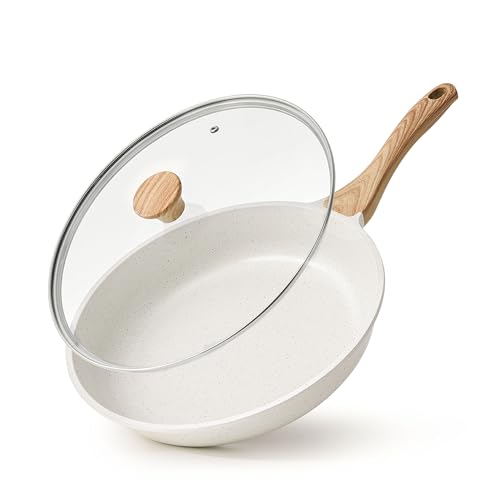
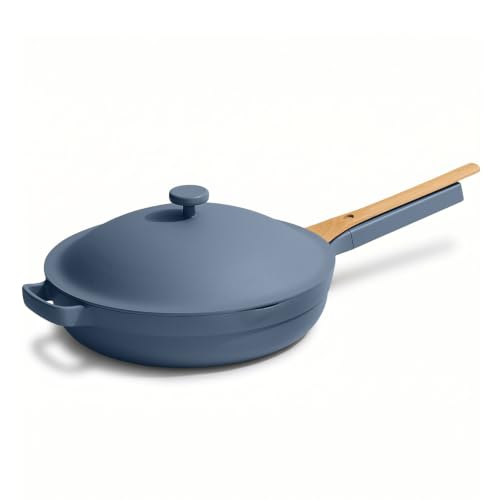
When an egg sticks on medium heat with a teaspoon of oil in a clean pan, the coating is spent, even if it looks fine. This is the normal end for ceramic pans, whose silica sol-gel film loses its slickness as the surface wears, a decline The Guardian reports can happen within months. Buyers of the Sensarte Ceramic Nonstick Frying Pan with Lid ($26.99, 4.4 stars, 10,690 ratings on Amazon as of October 2026) say the nonstick fades within a week for some, and the Our Place Always Pan 2.0 ($95.00, 4.3 stars, 3,531 ratings) gets mixed nonstick reports at the highest price in this group.
Before you call it dead, rule out buildup: CR recommends a baking soda and water paste left on for up to 24 hours to lift the sticky film that cooking sprays leave behind. If a cleaned pan still sticks, it is done.
Sign 4: a warped base
Drop a hot pan into cold water and it can warp. CR warns this is "especially true for nonstick pans, which tend to be lightweight and more prone to warping," in Don't ruin that nonstick frying pan. A warped pan rocks, heats unevenly, and on a glass or induction cooktop may barely heat in the middle, whatever shape the coating is in.
Sign 5: stains and a tacky feel that will not clean (ceramic and light-colored granite)
Light-colored coatings show staining early. Buyers of the Carote 10-Inch Granite Nonstick Frying Pan with Glass Lid ($29.99, 4.6 stars, 7,087 ratings) report staining after the first use and noticeable wear at around eight months. A stain by itself is cosmetic. A stain that still feels tacky after washing is cooked-on oil bonded to the coating, and once the baking-soda soak stops lifting it, the surface underneath is usually worn as well.
Handles are the other early failure. The Sensarte 9.5-Inch Swiss Granite Frying Pan ($17.99, 4.4 stars, 35,410 ratings) has roughly 1,300 durability mentions on Amazon, many about handles breaking at around three months. A loose handle on a pan of hot oil is a replace-now problem, whatever the coating looks like.
Swallowed PTFE flakes and the cancer question
The honest answer from the sources that have looked at swallowed flakes: no one has shown harm, and no one has fully studied it either.
- Scientific American says that "ingesting small flakes of nonstick coating is not dangerous. The material will most likely just pass through the body."
- The FDA has authorized PTFE for nonstick cookware since the 1960s and says the coating is bonded at very high temperature so that only negligible amounts of PFAS can migrate to food.
- A 2022 study in Science of the Total Environment, summarized by Flinders University, used Raman imaging to estimate that a single crack in a Teflon coating can shed about 9,100 particles, and a broken coating about 2.3 million micro- and nanoplastics. The authors did not claim harm. Co-author Cheng Fang said the particles "might be a health concern so needs investigating because we don't know much about these emerging contaminants."
So: a flake most likely passes through; a worn pan sheds far more than one flake; and the long-term effect of those particles is unstudied. That is a reason to replace a damaged pan, not a reason to panic over last night's omelet. If you have a health condition and are worried about any exposure, ask your doctor.
Now the search phrase "scratched nonstick pan cancer." The cancer concern attached to Teflon comes from PFOA, a chemical once used to manufacture PTFE, not from the coating itself. The American Cancer Society notes that IARC classifies PFOA as carcinogenic to humans, based on animal evidence and human studies linking it to testicular and kidney cancer; its page deals with exposure through drinking water, food packaging and workplaces, and says PFOA and PFOS "are now no longer made in the US." Under the EPA's PFOA Stewardship Program, the eight major makers committed to work toward eliminating PFOA from products by 2015, and all report meeting that goal; Healthline puts its removal from Teflon-brand products at 2013.
None of the sources we opened links a scratched PTFE pan to cancer in a person, and the ACS page does not address cookware scratches at all. The documented hazard from PTFE is heat: above roughly 500°F the coating breaks down and the fumes cause polymer fume fever, a temporary flu-like illness, per Poison Control and Healthline. For the full history see Is Teflon safe in 2026?, and for the ceramic side, is ceramic nonstick cookware safe?.
What to replace it with
If this is your third nonstick pan, consider not buying a fourth. CR's 2026 report says stainless steel and cast iron, "with proper care, can last a lifetime." Our best non-toxic pans ranking sorts the options into Avoid, OK and Best by material, and ceramic vs stainless vs cast iron vs carbon steel matches each to the jobs it does well.
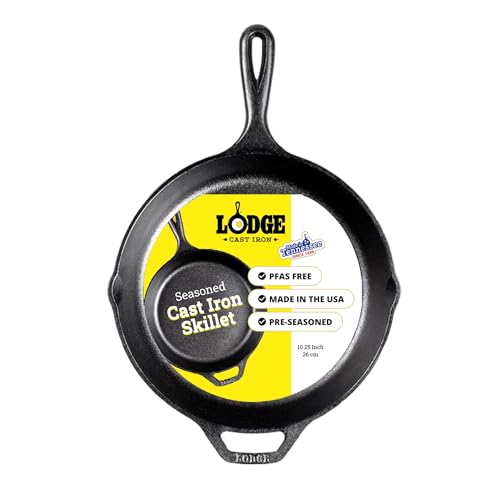
- Eggs and delicate fish without a coating: the Lodge 10.25-Inch Cast Iron Skillet ($22.91, 4.6 stars, 87,490 ratings) once the seasoning builds; buyers warn it can rust after the first wash and sticks early on.
- Searing and pan sauces: the Cuisinart Chef's Classic Stainless 11-Piece Set ($113.15, 4.3 stars, 9,820 ratings); staining and sticking are the common complaints, both manageable with heat control.
- One more nonstick for eggs only: a cheap ceramic pan such as the Sensarte above, bought knowing it is a consumable and kept under the rules in our ceramic care guide.
Budget picks across all three materials are in best non-toxic cookware on a budget.
Bottom line
Chips, flakes, peeling or a scratch down to metal: replace the pan now, whatever the coating. Sticking at medium heat with oil, a warped base, or a surface that stays tacky after a baking-soda soak: the pan has finished its useful life. Swallowed PTFE flakes most likely pass through, and no source we opened links a scratched pan to cancer, but a worn pan sheds millions of unstudied particles, so retiring it is cheap insurance. If this is a repeat purchase, the lifetime options are stainless and cast iron.
Sources
- Consumer Reports: How to make your nonstick frying pan last — accessed 2026-10-09
- Consumer Reports: Don't ruin that nonstick frying pan — accessed 2026-10-09
- Consumer Reports via Action News 5: How to break up with your nonstick pan (January 2026) — accessed 2026-10-09
- Healthline: Is Nonstick Cookware Like Teflon Safe to Use? — accessed 2026-10-09
- Poison Control: Teflon flu (polymer fume fever) — accessed 2026-10-09
- The Guardian via Yahoo News: Toxic truth? The cookware craze redefining 'ceramic' and 'nontoxic' (Tom Perkins, 9 June 2025) — accessed 2026-10-09
- Scientific American: Are Nonstick Pans Safe? — accessed 2026-10-09
- FDA: Authorized Uses of PFAS in Food Contact Applications — accessed 2026-10-09
- Flinders University: Not-so-tough Teflon (2022 study, Science of the Total Environment) — accessed 2026-10-09
- American Cancer Society: Teflon and Perfluorooctanoic Acid (PFOA) — accessed 2026-10-09
- EPA: Fact Sheet, 2010/2015 PFOA Stewardship Program — accessed 2026-10-09
Products mentioned in this guide
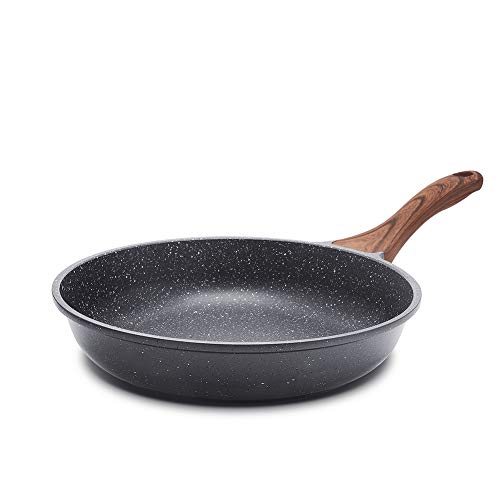
Sensarte 9.5-Inch Granite Pan: what 35,410 reviews say
At $17.99 with 35,410 Amazon ratings, this is one of the most-reviewed budget nonstick pans. Great for eggs, but some buyers report the handle breaking and mixed durability.

Carote 10-Inch Granite Pan with Lid: why it stains
A $29.99 granite-style nonstick skillet with a lid and 7,087 Amazon ratings. Fine for casual cooks on a budget, but buyers flag staining and mixed durability.
Sensarte Ceramic Frying Pan: is ceramic nonstick worth it?
A $26.99 ceramic-coated pan (price varies by size) with a glass lid. Buyers like the even heat and easy cleanup, but nonstick performance and durability are mixed.
Our Place Always Pan 2.0: is it worth $95?
A $95 ceramic nonstick pan that replaces several pieces with a steamer basket and spatula. Buyers like the cooking, but value and nonstick feedback are mixed.
Carote 21-Piece Ceramic Set: does the coating peel?
A $99.99 twenty-one-piece ceramic set with 4.6 stars from 3,935 ratings. Buyers like the value and cleanup, but some report the nonstick coating peeling and handles getting hot.

Sensarte 13-Piece Ceramic Set: $65.95, 6,447 reviews, one flaw
A $65.95 thirteen-piece ceramic set that covers a frying pan, sauté pan, saucepan and casserole. Buyers like the look and value, but reviewers report chipping handles and sticking.
Lodge 10.25-Inch Cast Iron Skillet: 87,490 reviews, rust explained
The classic American cast iron skillet at about $22.91 with 87,490 Amazon ratings. Tough and versatile, but some buyers report rust after first use and food sticking.

Cuisinart Chef's Classic Stainless Set: no coating, some staining
A $113.15 stainless steel set with aluminum-encapsulated bases and glass lids, no nonstick coating. Buyers like the look and even heat, but some report staining and food sticking.
Some links on this site are affiliate links. If you buy through them we may earn a small commission, at no extra cost to you.