Home › Guides › Buying guides
Plastic-free electric kettles: 6 parts that touch the water
Judge a plastic-free kettle by six water-contact parts, not its body. Glass and 304 stainless interiors shed no plastic; lids, filters and base rings are where plastic hides.
No electric kettle sold on Amazon is entirely plastic-free. The outer housing, the switch, the handle and the power base are almost always plastic. What matters is whether plastic touches the water, and on a typical kettle six separate parts can: the underside of the lid, the water window or gauge, the filter at the spout, the max-fill mark, the ring where the body meets the base connector, and the interior itself. A "no plastic contact with water" claim is only as good as the weakest of those six.
Why hot water in plastic is the issue
Two studies set the scale.
In 2020, a Trinity College Dublin team published in Nature Food that polypropylene infant feeding bottles released up to 16,200,000 microplastic particles per litre during normal formula preparation, and that high-temperature water and sterilization sharply increased the release. Polypropylene, the plastic those bottles were made of, is a common choice for food-contact parts on small appliances.
In 2025, University of Queensland researchers reported in the journal npj Emerging Contaminants that boiling water in plastic kettles released close to 12 million nanoplastic particles per millilitre on the first boil, falling to about 820,000 per millilitre after 150 boils, according to the University of Queensland release. Hard tap water reduced the release, apparently because mineral scale coated the plastic. And the team advised discarding the water from the first several boils of any new plastic kettle.
Neither study claims a specific health outcome, and this article does not either. If you have a health condition and are worried about exposure, ask your doctor. The practical point is simpler: fewer plastic parts in boiling water means fewer particles, and glass or stainless steel does not shed plastic at all.
The six parts to check, one by one
Check these on the product photos or on the kettle in your hand.
- Lid underside. Steam condenses here and drips back into the water. Many "glass" kettles have a plastic lid with a plastic inner face. Look for a stainless inner lid plate.
- Water window or gauge. On a plastic-bodied kettle this is a clear plastic strip in constant contact with water. A glass kettle has no separate window, because the body is the gauge. A stainless kettle usually has none.
- Filter at the spout. Cheap ones are nylon mesh in a plastic frame; better ones are stainless mesh.
- Max-fill mark. On glass and steel kettles it is printed or etched on the body. On some mixed-material kettles the mark sits on a plastic insert.
- Base connector ring. The heating plate is stainless, but the seal between plate and body, and the ring around it, can be plastic or silicone.
- Interior walls. Glass on a glass kettle, steel on a stainless kettle, and on a plastic kettle the largest contact area of all.
If a listing only answers one or two of these, treat "plastic-free" as a partial claim.
Glass kettles: borosilicate or soda-lime
Two kinds of clear glass show up in kettles. Borosilicate expands very little when heated, with a thermal expansion coefficient of about 3.3 × 10⁻⁶ per kelvin, roughly one-third that of ordinary soda-lime glass, according to the Wikipedia entry on borosilicate glass. The same entry puts the sudden temperature change borosilicate tolerates at about 170 °C (330 °F), against roughly 40 °C (100 °F) for soda-lime. In a kettle, that is the difference between a body that takes cold tap water right after boiling and one that may crack.
Listings often do not say which glass they use. Cosori's glass kettle page says "premium stainless steel and glass materials" without naming the type; the user manual lists specifications but not the glass grade. Treat any "borosilicate" wording on third-party listings as unverified.
Stainless kettles: 304 or 430
"Stainless steel" covers many alloys. The two you will meet in kettles are 304 and 430.
- 304 contains 18 to 20 percent chromium and 8 to 11 percent nickel, and is not magnetic, per the Wikipedia entry on SAE 304. It is the standard food-contact grade.
- 430 contains 16 to 18 percent chromium and under 0.75 percent nickel, is magnetic, and costs less; AZoM's grade 430 datasheet says 304 offers slightly higher corrosion resistance.
A fridge magnet is a rough field test: it sticks to 430 and slides off 304. Both work in a kettle; the difference shows up over years of hard water and vinegar descaling, where 304 is the more corrosion-resistant of the two. Whether nickel in steel is something to think about at all is covered in our guide on stainless steel cookware, nickel and chromium.
The three Cosori kettles, part by part
Maker's claims below are quoted as written; weak points come from Amazon buyer feedback as of October 2026.
Cosori 1.7L Glass Electric Kettle ($24.43, 4.5 stars, 49,713 ratings on Amazon as of October 2026). Maker's claim on the Cosori product page: "no plastic contact with water" and "premium stainless steel and glass materials." The CO171-GK2 user manual adds that "the filter is made with food-grade stainless steel," rates the kettle at 1500 W and 1.7 L, and describes an auto shut-off at boil plus a dry-run cutoff. Parts covered by the claim: interior (glass), filter (steel), heating plate (steel). Parts not named in the manual: the lid underside and the ring at the base. The product page also carries a California Proposition 65 notice referencing lead; the page does not say which component triggers it. Buyer weak points: several report the kettle stopped working around four months, and the auto shut-off gets mixed reports.
Cosori 1.7L Stainless Steel Electric Kettle SE152 ($35.99, 4.5 stars, 5,486 ratings on Amazon as of October 2026). Maker's claim on the Cosori SE152 page: "304 food-grade stainless steel interior" and a "plastic-free stainless steel electric kettle interior lid and filter," with "auto shut-off protection." This is the most complete claim of the three because it names the interior, the inner lid and the filter. Not named: the max-fill mark and the base ring. Buyer weak points: reports of failure around ten months, and a much smaller review base than the glass model.
Cosori Gooseneck Electric Kettle, 0.8L ($79.99, 4.6 stars, 19,590 ratings on Amazon as of October 2026). The maker's listing text, as carried on the Drew & Jonathan retail page, reads: "Durable 304 food-grade stainless steel inner lid and bottom to avoid plastic taste," with 0.8 litres, 1200 W, five temperature presets and a one-hour keep-warm. The listing does not describe the ring at the base or the max line. Buyer weak points: reliability reports are mixed, and the price moves around a lot.
Each claim covers only the parts it names. The SE152 leaves the fewest unnamed; the glass model is the only one with a view of the water that needs no plastic strip.
First boils and everyday habits
Whatever kettle you buy, the Queensland team's advice applies: fill, boil and discard the first few batches before drinking. Cosori's own manual says the same thing in its own way, with a first-use "water test" and the instruction "do not drink the water that is boiled during this test." On any plastic part that remains, those early boils are where the particle burst the Queensland team measured is largest. Our guide on how to descale a glass or stainless kettle has the vinegar and citric acid ratios for keeping the filter and plate clean. If a kettle is one piece of a larger cleanup, the plastic-free kitchen swaps guide and the microplastics in the kitchen roundup rank the other sources.
For cookware rather than kettles, the ranking by material lives in our guide to the best non-toxic pans.
Bottom line
Judge a "plastic-free" kettle by its six water-contact parts, not its body. Glass and 304 stainless interiors do not shed plastic; the lid underside, filter and base ring are where plastic hides. Of the three Cosori kettles, the stainless SE152 names the most parts in its claim, the glass kettle is the cheapest way to get a glass interior and a steel filter, and the gooseneck is for pour-over, not volume. Discard the first few boils of any new kettle, whichever you choose.
Sources
- Li et al., Nature Food, 2020 — Microplastic release from polypropylene infant feeding bottles — accessed 2026-10-09
- University of Queensland news, 2025 — plastic particles from kettles — accessed 2026-10-09
- Wikipedia — Borosilicate glass — accessed 2026-10-09
- Wikipedia — SAE 304 stainless steel — accessed 2026-10-09
- AZoM — Stainless Steel Grade 430 — accessed 2026-10-09
- Cosori — Electric Tea Kettle product page — accessed 2026-10-09
- Cosori — CO171-GK2 Original Electric Glass Kettle user manual (PDF) — accessed 2026-10-09
- Cosori — 1.7L Stainless Steel Electric Kettle SE152 product page — accessed 2026-10-09
- Drew & Jonathan — Cosori Electric Gooseneck Kettle listing — accessed 2026-10-09
Products mentioned in this guide
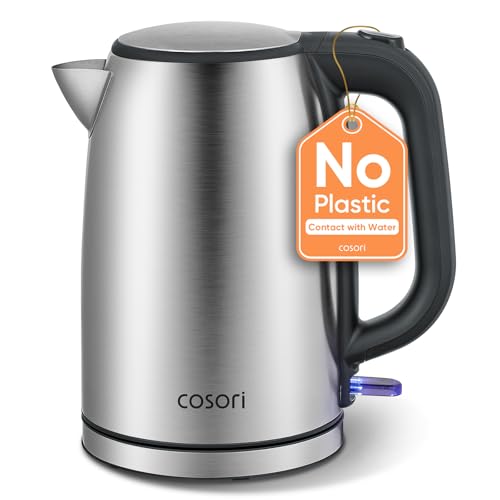
Cosori Stainless Steel Kettle: 304 steel inside, but does it last?
A $35.99 stainless steel kettle with a 304 stainless interior. Buyers praise speed and value, but some report it breaking after about 10 months.
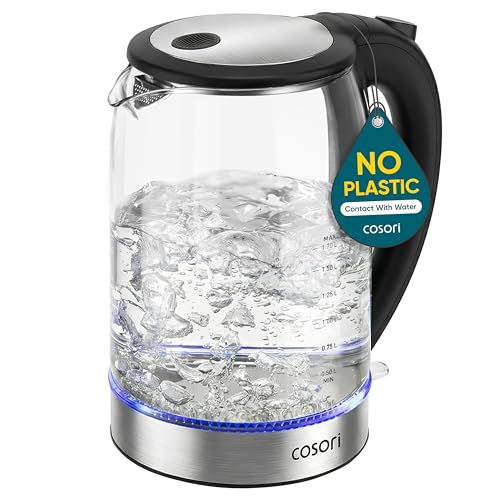
Cosori Glass Kettle: does water really never touch plastic?
A $24.43 borosilicate glass kettle that the maker says has no plastic touching the water. Heats fast and has 49,713 Amazon ratings, but durability is a clear concern.

Cosori Gooseneck Kettle 0.8L: 5 presets, is $79.99 justified?
A $79.99 gooseneck kettle with 5 temperature presets for coffee and tea. Highly rated, but reliability is mixed, and the price moved during one day.
Some links on this site are affiliate links. If you buy through them we may earn a small commission, at no extra cost to you.