Home › Guides › Care and cleaning
How to descale an electric kettle: vinegar vs citric acid
Limescale is calcium carbonate, harmless to drink but bad for the kettle. Remove it with vinegar or citric acid, skip bleach and steel wool, and set the schedule by water hardness.
Descale an electric kettle with a food acid, not a cleaning chemical. Pour in white vinegar and water, boil, let it sit, pour it out, then boil plain water once or twice to rinse. Citric acid or lemon does the same job with less smell. The white crust you are removing is limescale, which is mostly calcium carbonate; it is not toxic, it just slows the kettle, clogs the filter and flakes into your cup.
What limescale is, and why it is not a health problem
Tap water carries dissolved calcium and magnesium. When that water is heated, carbon dioxide leaves it, and the calcium that was dissolved drops out as solid calcium carbonate on the hottest surface, which in a kettle is the heating plate. The Wikipedia entry on limescale describes it as "a hard, chalky deposit, consisting mainly of calcium carbonate" and walks through that chemistry.
The minerals themselves are not a hazard. Penn State Extension's page on water softening says that from a health standpoint calcium and magnesium "have no adverse effects and are, in fact, essential daily nutrients." The UK's Drinking Water Inspectorate notes "some limited evidence" of a link between harder water and better cardiovascular health, in its water hardness page, and Thames Water's hardness page states plainly that hard water "is not considered harmful."
So a flake of scale in your tea is unpleasant, not dangerous. The reasons to descale are mechanical: scale insulates the heating plate, which makes boiling slower and the element hotter, and Penn State notes that buildup can "decrease the useful life" of water heaters. The same applies to a kettle.
One side note from a 2025 University of Queensland study: on plastic kettles, a layer of scale actually reduced the release of nanoplastic particles into the water, per the UQ release. That is not a reason to keep scale; it is a reason to pick a kettle whose water path is not plastic, which our guide on plastic-free electric kettles sorts out part by part.
Vinegar: the ratios the makers actually print
Ratios in blog posts range widely. These come from manufacturer manuals and support pages.
- Cosori (glass and stainless models): the CO171-GK2 manual and the CDK-SE151 stainless manual give the same steps: add "½ US cup / 118 mL of distilled vinegar," then "2 US cups / 473 mL of water," boil the mixture, pour it out, wipe remaining scale with a non-abrasive sponge, repeat as needed. That is roughly one part vinegar to four parts water.
- Wilfa (Norwegian kettle maker): "one part ordinary vinegar and two parts water," filled to max, heated until the kettle switches off, left overnight, emptied, then a plain-water boil discarded before use, per the WKD-2200S care page.
- Tefal: half a litre of 8° (about 8 percent) white vinegar, cold, left to stand one hour, then rinsed five or six times, per the Tefal kettle instructions.
- Bob Vila (home-care publisher): fill halfway with equal parts cold water and white vinegar, boil, then let the solution sit 30 minutes to an hour, per the Bob Vila descaling guide.
A working rule from those four: light scale, one part vinegar to three or four parts water, one boil, pour. Heavy scale, one to one or one to two, boil and soak an hour or overnight. Always finish with one or two boils of plain water, discarded, so the next cup does not taste of pickle.
Citric acid and lemon: the low-smell option
Citric acid is a dry powder sold in the canning aisle, and it leaves no vinegar odor. Tefal's instructions specify heating half a litre of water, adding 25 grams of citric acid, and letting it stand 15 minutes before rinsing. Cosori's manuals accept "half a lemon" squeezed into the kettle in place of the vinegar, followed by the same two cups of water and a boil. Bob Vila's version is the juice of one lemon or lime topped with cold water to the halfway mark, then the same 30- to 60-minute soak. Lemon is weaker and more variable than measured citric acid, so for a crusty plate use the powder.
What not to use
- Bleach, oven cleaner, drain cleaner, dishwasher tablets. None of the manuals above mention them, and Tefal's instructions warn: "Never use other methods of descaling other than the recommended methods." They are not acids, so they do little against calcium carbonate, and they leave residue in a vessel you drink from.
- Steel wool or scouring powder. Cosori's manual says: "Do not use steel wool, as this can scratch the kettle." Scratches in glass become stress points; scratches in stainless hold scale.
- Soaking the base. Both Cosori manuals repeat: never immerse the kettle or power base in water. Descaling liquid stays inside; the outside and the contacts get a damp cloth only.
- Running the kettle dry to "burn off" scale. Cosori's manuals describe a dry-run cutoff that exists to keep the heating plate from overheating; defeating it on purpose is the opposite of maintenance.
Glass, stainless and gooseneck kettles: the small differences
The acid and the ratios are the same for all three. The handling differs.
Glass, such as the Cosori 1.7L Glass Electric Kettle: you can see the scale, which makes it easy to judge when a second round is needed. Let the kettle cool before adding cold vinegar solution; a hot glass body and a cold pour is the kind of thermal shock that cracks soda-lime glass. The stainless spout filter is where flakes collect; rinse it under the tap after each descale rather than scrubbing it.
Stainless, such as the Cosori 1.7L Stainless Steel Kettle SE152: you cannot see the plate, so go by boil time; a kettle that takes longer and rumbles is scaled. Rinse well; none of the makers above recommends leaving acid in a steel kettle for more than a night. Our guide on cooking on stainless steel without sticking covers the same alloy question for pans.
Gooseneck, such as the Cosori Gooseneck Kettle, 0.8L: the small 0.8-litre body needs proportionally less, about a quarter cup of vinegar to a cup of water. The narrow spout is the trouble spot; after soaking, pour the solution out through the spout slowly so the acid runs the full length of the neck, then run two plain-water pours the same way. The temperature presets help here: a 175 °F or 200 °F hold does the soak without a full boil.
How often, by water hardness
Penn State Extension classifies water under 60 mg/L of calcium carbonate as soft or slightly hard, 60 to 120 as moderately hard, 120 to 180 as hard, and over 180 as very hard. Your water utility's annual quality report lists your number.
- Soft water: descale every two to three months, or whenever flakes appear.
- Moderately hard: about once a month, which is also Bob Vila's general recommendation.
- Hard or very hard: every two to four weeks. Tefal's "every 20 to 40 uses" and Cosori's "at least once a week if you use it frequently" both land here for a household that boils several times a day.
Cosori's manuals add one more rule: descale before and after storing the kettle for a long period. An empty kettle with a dried-on crust is harder to clean later.
Descaling is one chore in a larger routine. The site's hub on caring for non-toxic cookware ties it together with cast iron, stainless and ceramic care, and the microplastics in the kitchen guide ranks the other sources worth swapping.
Bottom line
Limescale is calcium carbonate: harmless to drink, bad for the kettle. Remove it with vinegar at one part to two to four parts water, or 25 grams of citric acid in half a litre of hot water, soak 15 minutes to overnight depending on buildup, then boil and discard plain water. Skip bleach, oven cleaner and steel wool. Set the schedule by your water: monthly for moderately hard water, every couple of weeks for hard water, and before any long storage.
Sources
- Wikipedia — Limescale — accessed 2026-10-09
- Penn State Extension — Water Softening — accessed 2026-10-09
- Drinking Water Inspectorate (UK) — Water Hardness / Hard Water — accessed 2026-10-09
- Thames Water — Hard water — accessed 2026-10-09
- University of Queensland news, 2025 — plastic particles from kettles — accessed 2026-10-09
- Cosori — CO171-GK2 Original Electric Glass Kettle user manual (PDF) — accessed 2026-10-09
- Cosori — CDK-SE151-KUS Double-Wall Stainless Steel Electric Kettle user manual (PDF) — accessed 2026-10-09
- Wilfa — WKD-2200S cleaning and maintenance — accessed 2026-10-09
- Tefal — Kettle & Tea Maker instructions for use — accessed 2026-10-09
- Bob Vila — How to Descale a Kettle — accessed 2026-10-09
Products mentioned in this guide
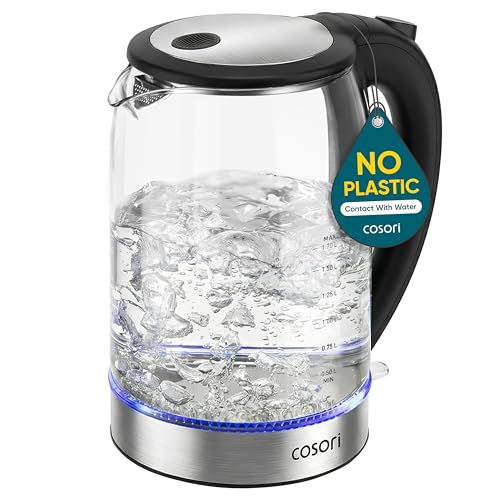
Cosori Glass Kettle: does water really never touch plastic?
A $24.43 borosilicate glass kettle that the maker says has no plastic touching the water. Heats fast and has 49,713 Amazon ratings, but durability is a clear concern.
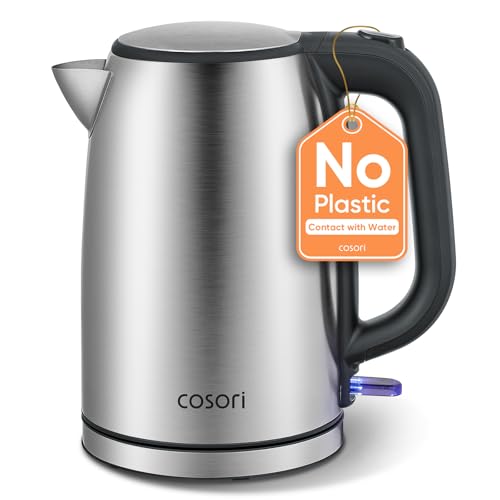
Cosori Stainless Steel Kettle: 304 steel inside, but does it last?
A $35.99 stainless steel kettle with a 304 stainless interior. Buyers praise speed and value, but some report it breaking after about 10 months.

Cosori Gooseneck Kettle 0.8L: 5 presets, is $79.99 justified?
A $79.99 gooseneck kettle with 5 temperature presets for coffee and tea. Highly rated, but reliability is mixed, and the price moved during one day.
Some links on this site are affiliate links. If you buy through them we may earn a small commission, at no extra cost to you.