Home › Guides › Care and cleaning
How to cook on stainless steel without sticking: water-drop test
Heat the empty pan on medium, wait until water drops roll like beads (the Leidenfrost effect), then add oil and food and let it release on its own. Vinegar and Bar Keepers Friend fix the stains.
Food stops sticking to stainless steel when you do three things in order: heat the empty pan on medium for 2 to 4 minutes, confirm it is ready with a few drops of water (they should roll around like beads, not sizzle flat or vanish), then add the oil and the food. After that, leave the food alone until it releases on its own. That is the whole method, and it rests on a piece of physics called the Leidenfrost effect. Everything else on this page is detail.
Why food sticks to a cold stainless pan
Stainless steel has no coating. When raw protein meets a pan that is not hot enough, it bonds to the metal and you end up scraping. America's Test Kitchen puts it plainly: add food before the water beads up and you get sticking and caked-on residue (America's Test Kitchen). All-Clad's beginner guide says the same from the maker's side: "Preheat your pan before adding any food to the cooking surface" (All-Clad).
This is why the most repeated complaint on the Cuisinart Chef's Classic Stainless 11-Piece Set (4.3 stars, 9,820 ratings on Amazon as of October 2026) reads "food sticks without heat/fat." Buyers are describing a cold pan and a dry pan, not a broken one. If you are weighing stainless against other materials, our guide to non-toxic cookware materials covers the trade-offs; this page assumes you already own the pan.
The Leidenfrost effect, in one paragraph
Drop water on a pan that is only warm and it spreads and boils off. Drop it on a pan that is hot enough and the bottom of the drop flashes to steam instantly; that thin layer of vapor lifts the rest of the drop so it skates across the metal like a puck. That is the Leidenfrost effect, named for the German physician Johann Gottlob Leidenfrost, who described it in the 1700s. For water on a hot surface the effect kicks in at roughly 193°C (379°F) (Wikipedia, Leidenfrost effect). All-Clad puts the kitchen version at 350–375°F (All-Clad); America's Test Kitchen says about 365–379°F (ATK).
Food is mostly water. At that surface temperature the moisture on the underside of a chicken thigh does the same thing the drop did: it turns to steam and briefly holds the meat off the metal while a crust forms. ATK compares it to an air hockey puck. Once the crust is there, the food lets go.
The water-drop test, step by step
- Put the dry, empty pan on a burner set to medium. All-Clad's own care guide says to preheat "on low to moderate heat," and that "Water will dance on the pan when ready" (All-Clad use and care).
- Wait 2 to 4 minutes. That is ATK's range; All-Clad says 2 to 3 (ATK, All-Clad).
- Flick in a few drops of water from your fingertips, or about a teaspoon.
- Read the result:
- Drops sit flat, sizzle and foam: too cold. Wait another minute and test again.
- Drops gather into one or two beads that roll and skitter: ready. ATK: "when they roll and skitter around like balls, the pan is ready."
- Drops explode into many tiny beads and vanish: too hot. Pull the pan off the heat for 20 to 30 seconds, then test again.
- Wipe or tip out any leftover water. Now add the oil.
Do the test every time until it becomes automatic. Burners and pans differ.
Hot pan, then oil, then food
The order matters. Oil added to a cold pan gives you no signal about the pan's temperature. Oil added to a hot pan spreads thin in seconds and tells you it is ready when it shimmers. All-Clad: "once the oil is shimmering or when the butter has finished bubbling, you are ready to begin cooking" (All-Clad).
Two things to avoid at this step:
- Do not go to high heat. All-Clad limits high heat to boiling liquids and says to "use medium to moderate heat to avoid damaging your pan." The company's care page adds that an empty pan left on a hot burner can be damaged and that overheating causes the brown or blue stains (All-Clad use and care).
- Do not skip the fat. The steam layer helps the food release; the fat is what browns the surface and keeps it from drying out. The Cuisinart complaint above has "fat" in it for a reason.
Let the protein release itself
Put the chicken, steak or fish in the pan and do not touch it. Flip after 30 seconds and it tears, and you decide the pan is bad. All-Clad's advice: gently nudge the food from side to side; "If you encounter resistance, give it some more time" (All-Clad). When the crust is set, the piece slides.
The brown film left on the pan afterward is fond, not failure. Deglazing with a splash of water, stock or wine lifts it into a sauce and does most of the cleanup for you.
Eggs on stainless steel
Eggs are the test everyone fails first, and they work on stainless with the same method plus more fat. ATK's article says the technique works for eggs and fish, and that its test omelets came out clean (ATK). All-Clad's one extra rule for eggs: "ensure you use enough oil to coat the entire surface" (All-Clad).
In practice: pass the water test, add enough butter or oil to film the whole floor of the pan, turn the burner down to medium-low, then add the eggs. Scrambled eggs should be moved constantly with a silicone spatula; a fried egg should sit until the white is set at the edges before you slide a thin spatula under it. If you want eggs with zero effort every morning, a ceramic pan is the easier tool, and how to make a ceramic nonstick pan last longer explains the heat and spray rules that keep it working.
Cleaning the stains that stainless picks up
Stainless does not scratch like a coating, but it does discolor, and the Cuisinart set's other top complaint is staining. Every mark below has a maker-approved fix.
- Rainbow or blue heat tint: wipe with a sponge and white vinegar, rinse, dry (All-Clad use and care).
- White spots or film: mineral deposits from hard water, or salt added before the water boiled. A vinegar rinse removes the deposits; add salt only after the water boils to avoid the tiny pits (All-Clad use and care, All-Clad cleaning guide).
- Burnt-on food: simmer equal parts water and white vinegar, then let it cool and scrub, or use a baking soda paste for 5 to 10 minutes (All-Clad cleaning guide).
- Scorched, stubborn stains: Bar Keepers Friend. Its own instructions: dampen the pan, make a paste of powder and water, apply with a soft cloth, let it sit one minute ("DO NOT let the paste sit any longer"), rub in circles from the center out, then wash in hot soapy water (Bar Keepers Friend). All-Clad names Bar Keepers Friend and Bon Ami as its recommended cleaners and says to avoid steel wool, bleach and peroxide cleaners (All-Clad use and care).
Two don'ts from Bar Keepers Friend: never put a hot pan under cold water, which can warp or crack it, and never use chlorine bleach, which attacks the chrome oxide layer and causes pitting (Bar Keepers Friend do's and don'ts). Rinse the cleanser off completely and dry the pan so that layer can rebuild.
The other materials in your cabinet have their own routines, collected in how to care for non-toxic cookware. If a scorched stainless pan has you thinking about cast iron instead, the Lodge 10.25-Inch Cast Iron Skillet is the usual starting point, and how to clean a cast iron skillet shows that its cleanup is simpler than its reputation.
Bottom line
Stainless steel is not a sticky material; a cold stainless pan is. Heat it on medium until a drop of water rolls like a bead, add the fat, add the food, and wait for it to release. Vinegar handles the rainbow tint and white spots; Bar Keepers Friend handles the scorch marks, one minute at a time. Learn the water test once and the Cuisinart Chef's Classic set cooks the way its 4.3-star average suggests it should.
Sources
- Wikipedia, Leidenfrost effect — accessed 2026-10-09
- America's Test Kitchen, How to Make Stainless Steel Nonstick — accessed 2026-10-09
- All-Clad, How to Cook with Stainless Steel: Simple Tips for New Cooks — accessed 2026-10-09
- All-Clad, Use and Care Guide — accessed 2026-10-09
- All-Clad, How to Clean Stainless Steel Cookware — accessed 2026-10-09
- Bar Keepers Friend, How to Clean Stainless Steel Pans — accessed 2026-10-09
- Bar Keepers Friend, 8 Do's and Don'ts for Cleaning Stainless Steel — accessed 2026-10-09
Products mentioned in this guide

Cuisinart Chef's Classic Stainless Set: no coating, some staining
A $113.15 stainless steel set with aluminum-encapsulated bases and glass lids, no nonstick coating. Buyers like the look and even heat, but some report staining and food sticking.
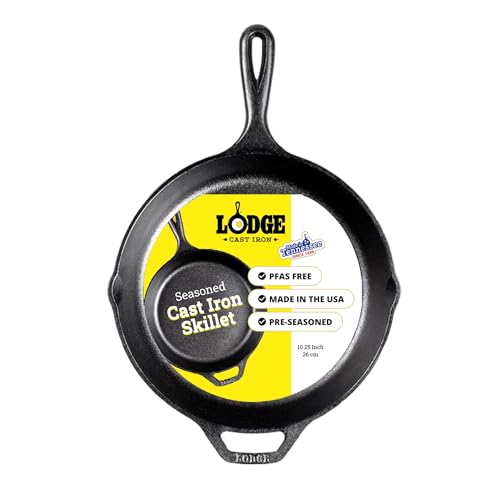
Lodge 10.25-Inch Cast Iron Skillet: 87,490 reviews, rust explained
The classic American cast iron skillet at about $22.91 with 87,490 Amazon ratings. Tough and versatile, but some buyers report rust after first use and food sticking.
Some links on this site are affiliate links. If you buy through them we may earn a small commission, at no extra cost to you.