Home › Guides › Cookware materials, explained
Is stainless steel cookware safe? Nickel, chromium and leaching
Stainless has no coating or fumes; it leaches small amounts of nickel and chromium into long acidic simmers, which matters mainly for people with a nickel allergy.
Stainless steel cookware has no coating to flake and no fume problem at any stove temperature, which is why it is the default answer to "what should I cook in." It does release small amounts of nickel and chromium into food, mostly when acidic food like tomato sauce simmers in it for hours, and mostly from a new pan. For most people those amounts are a footnote. For people with a nickel allergy they can matter, and that is a conversation for your doctor, not a cookware site. Stains and rainbow marks are a cleaning issue, not a sign the pan has failed.
What 18/10 and 18/8 mean
The numbers are percentages. According to the manufacturing reference Xometry, 18/10 stainless contains "roughly 18% chromium and 10% nickel," the rest mostly iron, and "in the U.S., this steel goes by 18/10 or 304." The same page gives the differences: 18/8 has 8% nickel instead of 10, and 18/0 has none. Xometry credits the "high chromium and nickel content" for corrosion resistance and the nickel for the shinier finish; it is also the expensive part. 304 belongs to the austenitic, non-magnetic family.
Grade 430 is the nickel-free option. AZoM lists it at 16–18% chromium and under 0.75% nickel, ferritic and magnetic, with pitting resistance "quite similar to that of grade 304" and uses like dishwasher linings and stove trim. If a pan is sold as "nickel-free stainless," 430 is usually what that means; check the listing.
What leaches, and how much: the 2013 study
The study everyone cites is Kamerud, Hobbie and Anderson, published in the Journal of Agricultural and Food Chemistry in 2013 and free to read at PubMed Central. The Oregon State team simmered four brands of commercial tomato sauce (pH about 4.2) in standard reference stainless steels equivalent to 304 and 316, plus an off-the-shelf 316 saucepan, for 2 to 20 hours and through 10 repeated cooking cycles.
What they measured:
- After six hours, nickel in the sauce rose up to 26-fold and chromium up to 7-fold over sauce cooked without stainless, depending on grade.
- After 20 hours, nickel reached 95-fold and chromium 9-fold.
- A new saucepan cooked for 20 hours put 483 µg of nickel and 67.5 µg of chromium into a 126 g serving.
- Leaching fell with each cycle and "stabilized after the sixth cooking cycle." By the tenth cycle a serving still carried about 88 µg of nickel and 86 µg of chromium.
Two things in that list deserve weight. First, nobody simmers pasta sauce for 20 hours; the six-hour and ten-cycle numbers are the realistic ones, and the shortest trial in the study was two hours. Second, a new pan leaches most. The authors' recommendation was aimed at a specific group: "individuals sensitive to metals lower their exposure," noting that 67 µg of nickel has caused skin reactions in sensitized people in other studies and that their saucepan data exceeded that. The paper does not claim harm for the general population, and neither do we.
Who should care: nickel allergy
Nickel is "the most common cause of contact allergy worldwide," per a dermatology review in The Hospitalist, which cites the North American Contact Dermatitis Group finding 17.5% of patch-tested patients positive to nickel in 2015–2016. The same review notes a meta-analysis estimating that about 1% of nickel-sensitive people may react to nickel in a normal diet, and that foods such as chocolate, sunflower seeds, whole-grain flour and dried beans are the usual dietary sources.
Cleveland Clinic lists "cooking equipment and eating utensils" among nickel sources, describes a systemic nickel allergy syndrome triggered by eating nickel-containing foods, and lists symptoms from itching and rash to, in systemic cases, blisters, diarrhea and fatigue.
Put the two together and the picture is narrow but real. If you have a diagnosed nickel allergy, especially the systemic kind, a brand-new 18/10 pan simmering tomato sauce is one of the higher-nickel things you can do in a kitchen, and the researchers say so. What to do about it is a medical question: ask your doctor or dermatologist, who may suggest a nickel-free 430 pan, enameled cast iron, or simply avoiding long acidic simmers in stainless. If you have no nickel sensitivity, the sources we found give no reason to avoid stainless.
Stains and rainbow marks are not leaching
The Cuisinart Chef's Classic Stainless 11-Piece Set, $113.15 and 9,820 ratings at 4.3 stars on Amazon as of October 2026, draws two recurring complaints: staining and food sticking without enough heat or fat. Neither is a safety report. Buyers describe discolored interiors; the review summary has no reports of the pan failing or shedding anything, because there is no coating to shed. Discoloration is a cleaning job, and the sticking complaint has a one-minute fix, the water-drop test, both in our guide to cooking on stainless steel without sticking.
How stainless compares with the other materials
- PTFE nonstick has no leaching question but a heat ceiling around 500°F and a coating that wears. Details in our guide to whether Teflon is safe.
- Ceramic sol-gel is PTFE-free by the makers' claims and wears faster than PTFE; see is ceramic nonstick cookware safe.
- Cast iron leaches iron instead of nickel, most into acidic foods, which is a benefit for some and a concern for people with iron-overload conditions.
- Enameled cast iron handles acidic food with no metal contact at all, as long as the enamel is intact.
- Stainless is the only one of the five with both no coating and no reactive surface for anyone without a nickel sensitivity.
The full six-way breakdown, with heat limits and lifespan for each, is in our guide to non-toxic cookware materials. Which brands have published metals tests is in the cookware lab test tracker, and what "non-toxic" on a stainless box is allowed to mean is in PFAS-free vs PFOA-free vs "non-toxic" labels.
Practical rules
- Break in a new stainless pan with a few non-acidic meals first. The 2013 study found leaching fell with each cycle and leveled off after the sixth.
- Keep long acidic simmers (tomato, wine, citrus) to enameled cast iron if you are nickel-sensitive; otherwise a short sauce in a used pan sits at the low end of the study's range.
- Treat stains as a cleaning job, not a replacement signal.
- For kettles, a stainless interior avoids the plastic question: the Cosori Stainless Steel Electric Kettle, $35.99 at 4.5 stars with 5,486 Amazon ratings as of October 2026, uses a 304 interior by the maker's description, with "no plastic contact" as a maker's claim.
Bottom line
Stainless steel cookware is safe to cook with for people without a nickel allergy, on the evidence available: no coating, no fumes, and metal leaching that is small outside of hours-long acidic simmers in a new pan. If you have a nickel allergy, the leaching numbers are real enough to raise with your doctor, and nickel-free 430 or enameled cast iron are the usual workarounds. Stains and rainbow marks do not change any of this. If you have a health condition, ask your doctor before changing cookware.
Sources
- Xometry — 18/10 stainless steel — accessed 2026-10-09
- AZoM — Stainless steel grade 430 — accessed 2026-10-09
- Kamerud, Hobbie, Anderson — Stainless steel leaches nickel and chromium into foods during cooking, J Agric Food Chem 2013 (PMC4284091) — accessed 2026-10-09
- The Hospitalist — Contact allergy to nickel: still #1 after all these years — accessed 2026-10-09
- Cleveland Clinic — Nickel allergy — accessed 2026-10-09
Products mentioned in this guide

Cuisinart Chef's Classic Stainless Set: no coating, some staining
A $113.15 stainless steel set with aluminum-encapsulated bases and glass lids, no nonstick coating. Buyers like the look and even heat, but some report staining and food sticking.
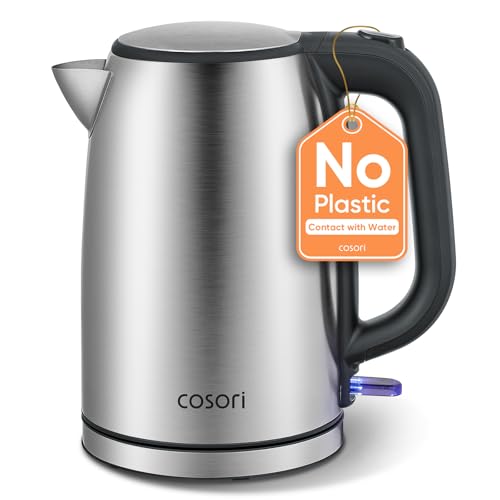
Cosori Stainless Steel Kettle: 304 steel inside, but does it last?
A $35.99 stainless steel kettle with a 304 stainless interior. Buyers praise speed and value, but some report it breaking after about 10 months.
Some links on this site are affiliate links. If you buy through them we may earn a small commission, at no extra cost to you.