Home › Guides › Cookware materials, explained
Is HexClad non-toxic? The $2.5M lawsuit and the 2024 change
HexClad's Hybrid pans used PTFE and the brand settled a $2.5M class action over non-toxic claims. Its 2024 TerraBond ceramic is PFAS-free by maker's claim only. Tough pan, not a bare material.
HexClad's original Hybrid pans were coated with PTFE, the same fluoropolymer as Teflon, and the company acknowledged that chemical was present in some of its products while settling a 2023 class action for $2.5 million without admitting wrongdoing. In 2024 the brand switched to a sol-gel ceramic coating it calls TerraBond, which it describes as PTFE-free and PFAS-free; that is a maker's claim backed so far by a PFAS-only lab screen. By this site's definition, which reserves "non-toxic" for bare materials or coatings with a full public third-party report, HexClad is a durable hybrid pan with a ceramic nonstick layer, not a non-toxic pan.
What a HexClad hybrid pan actually is
A HexClad pan is a tri-ply body, aluminum sandwiched between stainless steel, with a laser-etched lattice of raised stainless hexagons on the cooking surface. The nonstick coating sits in the valleys between those peaks, so the steel takes the abuse from spatulas and the coating is partly shielded (LeafScore, HexClad vs Made In). That design is the whole pitch: a nonstick pan you can treat like stainless.
Gordon Ramsay fronts the brand. His endorsement runs across HexClad's site and ads, including the line that the sear he gets "is incredible, with absolutely no stick," and he was not named as a defendant in the lawsuit (Organic Authority; Chowhound). A chef's endorsement speaks to how a pan cooks, not to what the coating is made of. Our non-toxic cookware materials pillar sets out the six material families we compare everything against.
The PTFE years and the lawsuit
The class action was filed in California in 2023. Plaintiffs alleged that HexClad marketed its cookware as non-toxic and PFAS-free even though the Hybrid pans contained PTFE, which is a PFAS under the definitions used by regulators (Organic Authority). According to the same report, the company did not admit wrongdoing but acknowledged the chemical was present in some of its products.
The settlement terms, as reported by Chowhound in June 2025: $2.5 million; 20 eligible products, all carrying the Hybrid label except the 5-quart saucepan, plus at least nine sets that included a Hybrid pan; a class period of February 1, 2022 through March 31, 2024; and a claim deadline of November 14, 2025 (Chowhound; ClaimsHero). That deadline has passed. Parade reported that HexClad also agreed to stop labeling PTFE-coated pans as non-toxic or PFAS-free (Parade, via AOL). The New York Times later used the case as its lead example of why "nontoxic" and "PFAS-free" on a box do not mean what shoppers assume (PFAS Project Lab, summarizing The New York Times).
None of this says HexClad lied about performance. It used two unregulated words on a PTFE product, and that cost $2.5 million. We explain why those words are unregulated in PFAS-free vs PFOA-free vs non-toxic.
Was the PTFE itself the problem?
Two honest answers exist, and shoppers should hear both. PTFE is a solid polymer that begins to deteriorate at about 260 C (500 F) and decomposes above 350 C. Its breakdown fumes can cause polymer fume fever, flu-like symptoms that typically pass within a day or two of fresh air (Wikipedia, PTFE). Below those temperatures it is widely treated as inert, which is the cookware industry's position in its lawsuit against Minnesota's ban: fluoropolymer coatings do not dissolve, do not bioaccumulate in normal use, and are FDA-approved (Homepage News).
The other side is about manufacturing residue, not the polymer. When Consumer Reports had three pans tested for 96 PFAS compounds in 2022, the PTFE pan in the group, a Swiss Diamond sold as PFOA-free, averaged 4 parts per billion of PFOA plus other PFAS in its coating; the two ceramic pans showed none (Consumer Reports). That was not a HexClad pan, and no comparable public test of the old HexClad coating has surfaced. Minnesota's regulator settled the definitional question for its own market: PTFE is a PFAS and is banned from cookware sold there since January 1, 2025 (Minnesota Pollution Control Agency). The scratched-pan question gets a full treatment in Is Teflon safe in 2026?. If you have a health condition, ask your doctor about any of this rather than relying on a cookware guide.
TerraBond: what changed in 2024
HexClad's FAQ now says its pans use a proprietary TerraBond ceramic nonstick coating "which is PTFE-free and PFAS-free" (HexClad FAQ). That is a maker's claim. The FAQ does not say when the switch happened, does not describe what the coating is made of, and does not cite a lab.
LeafScore, which has tracked the brand since the PTFE era, reports that the change arrived quietly in 2024/25 without a public announcement, that HexClad has since published Light Labs PFAS results with every analyte below the lab's reporting limits, and that the testing covered PFAS only, not heavy metals, while the full composition of the coating is still not disclosed (LeafScore, Are HexClad pans worth it?; LeafScore, HexClad vs Made In). The same reviewer notes the ceramic version has only been around for a year or so, so its lifespan is unknown.
Two cautions apply to every sol-gel "ceramic" pan, HexClad included. The Guardian reported in June 2025 that no legal definition of "ceramic" exists for cookware, that these coatings are a silica-and-metal mixture sprayed on aluminum rather than fired clay, and that Washington State has ordered makers to disclose the ingredients because regulators do not know what replaced PTFE (The Guardian, via Yahoo News). Our ceramic nonstick guide covers what is known about sol-gel lifespan.
Is HexClad non-toxic by this site's standard?
This site uses "non-toxic" for two things only: bare materials with no coating to wear off (stainless, cast iron, carbon steel, enamel), and coated pans whose maker has published a third-party report covering both PFAS and heavy metals. Measured that way:
- Pre-2024 Hybrid pans with PTFE: no. They contain a PFAS by the OECD and Minnesota definitions, and the brand has agreed to stop calling them non-toxic.
- TerraBond pans: not yet. The PFAS screen is a real step and it came back clean per LeafScore's reading of the Light Labs results. A metals screen and a disclosed formula would move it into the same column as the brands in our cookware lab test tracker that publish full reports.
On durability, the hexagon design is the brand's strongest argument and the reason people pay for it. The claim that you can use metal utensils is the maker's; buyers on Amazon and review sites split on how long the valleys stay slick. No pan with a sol-gel layer should be assumed to last like bare steel.
What to buy instead, or alongside
If the appeal of HexClad is a pan you cannot ruin, bare materials deliver that with nothing to wear off. The Cuisinart Chef's Classic Stainless Steel 11-Piece Set is $113.15 with 4.3 stars from 9,820 ratings on Amazon as of October 2026; buyers report staining and food sticking when the pan is not preheated or oiled, which is a technique problem rather than a coating one. The Lodge 12-Inch Cast Iron Skillet with Silicone Handle Holder is $26.68, 4.6 stars, 70,566 ratings, heavy and hand-wash only, and will outlive any coating.
If the appeal is a cheap, slick ceramic surface for eggs, the Sensarte Ceramic Nonstick Frying Pan with Lid is $26.99, 4.4 stars, 10,690 ratings on Amazon as of October 2026. Some buyers say the nonstick fades within a week, which is the sol-gel trade-off at every price. Our ranked list by material is in Best non-toxic pans 2026.
Bottom line
HexClad built a tough, well-marketed hybrid pan and then put two words on it that it could not back up. The $2.5 million settlement closed that chapter, and the 2024 move to TerraBond ceramic removed PTFE from new pans by the maker's account and a PFAS-only lab screen. That makes current HexClad a ceramic-nonstick pan with a steel armor layer: better than its past, not yet a non-toxic pan by the standard this site uses. For a pan with nothing to argue about, buy stainless or cast iron and learn the heat.
Sources
- LeafScore, HexClad vs Made In — accessed 2026-10-09
- LeafScore, Are HexClad pans worth it? Not if PTFE is a concern — accessed 2026-10-09
- Organic Authority, Is HexClad non-toxic, really? — accessed 2026-10-09
- Chowhound, The cookware brand Gordon Ramsay reps is in trouble over 'nontoxic' claims — accessed 2026-10-09
- ClaimsHero, HexClad cookware PFAS class action settlement — accessed 2026-10-09
- Parade via AOL, Gordon Ramsay's bestselling cookware brand hit with safety scandal — accessed 2026-10-09
- PFAS Project Lab, summary of The New York Times 'How nontoxic is nontoxic cookware?' — accessed 2026-10-09
- Wikipedia, Polytetrafluoroethylene — accessed 2026-10-09
- Homepage News, Cookware group sues Minnesota — accessed 2026-10-09
- Consumer Reports, You Can't Always Trust Claims on Non-Toxic Cookware — accessed 2026-10-09
- Minnesota Pollution Control Agency, 2025 PFAS prohibitions — accessed 2026-10-09
- HexClad FAQ — accessed 2026-10-09
- The Guardian via Yahoo News, Toxic truth? The cookware craze redefining 'ceramic' and 'nontoxic' — accessed 2026-10-09
Products mentioned in this guide

Cuisinart Chef's Classic Stainless Set: no coating, some staining
A $113.15 stainless steel set with aluminum-encapsulated bases and glass lids, no nonstick coating. Buyers like the look and even heat, but some report staining and food sticking.
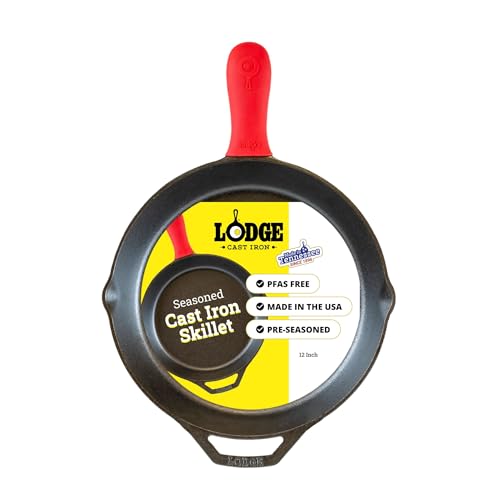
Lodge 12-Inch Cast Iron Skillet: too heavy, or just right?
A 12-inch pre-seasoned cast iron skillet at $26.68 with a red silicone handle holder and 70,566 Amazon ratings. Buyers praise durability, but size, weight and nonstick feedback are split.
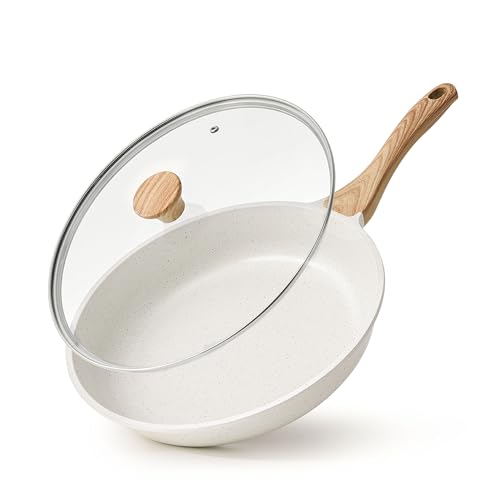
Sensarte Ceramic Frying Pan: is ceramic nonstick worth it?
A $26.99 ceramic-coated pan (price varies by size) with a glass lid. Buyers like the even heat and easy cleanup, but nonstick performance and durability are mixed.
Some links on this site are affiliate links. If you buy through them we may earn a small commission, at no extra cost to you.