Home › Guides › Air fryer know-how
Meat thermometer for air fryer chicken: safe temps, real speed
Chicken is safe at 165°F in the thickest part away from bone; whole cuts 145°F plus a 3-minute rest, ground meat 160°F. Speed and NIST figures on the box are maker's claims.
Air fryer chicken is done when a thermometer in the thickest part reads 165°F, the USDA minimum for all poultry. Whole cuts of beef, pork and lamb are safe at 145°F followed by a 3-minute rest, and ground meat at 160°F (USDA chart on FoodSafety.gov). An air fryer browns the outside fast, which makes color a worse guide than usual, so a $10 to $15 instant-read thermometer is the one accessory that changes outcomes. Below: the numbers, how to place the probe, what "1-second" and "NIST" on the box actually mean, and the weak spots in the three thermometers we review.
The numbers that matter
USDA's safe minimum internal temperatures, as published on FoodSafety.gov and dated November 2024:
- Chicken, turkey and other poultry, every form: 165°F. That covers whole birds, breasts, thighs, wings, ground poultry and stuffing inside a bird.
- Beef, pork, veal and lamb steaks, roasts and chops: 145°F, then rest 3 minutes before cutting.
- Ground beef, pork and sausage: 160°F.
- Fish: 145°F, or until the flesh is opaque and flakes.
- Leftovers, casseroles, reheated food: 165°F.
FDA publishes the same table and adds the sentence that explains why thermometers exist: "Color and texture are unreliable indicators of safety. Using a food thermometer is the only way to ensure the safety of meat, poultry, seafood, and egg products for all cooking methods" (FDA). CDC says the same: appearance alone cannot tell you food is safe (CDC).
The 3-minute rest on whole cuts is part of the rule, not a chef's preference. FoodSafety.gov explains that rest time "allows the innermost parts and juices of the meats to become fully and safely cooked." Pull a pork chop at 145°F and leave it on the board for three minutes before you cut.
Why air fryer chicken needs a thermometer more than oven chicken
An air fryer is a small convection oven with the fan close to the food. Surfaces brown and crisp in minutes. The center of a thick thigh or a stuffed breast is on its own schedule. Put a thin tender and a bone-in thigh in the same basket and the tender is done long before the thigh, while both look the same shade of golden. That is exactly the situation FDA's "color and texture are unreliable" line is about.
Crowding makes it worse, because stacked pieces shield each other from the airflow. Our guide to air fryer mistakes that ruin food covers crowding and skipping the halfway flip; both leave cold spots that a thermometer catches and your eyes do not.
How to place the probe
FoodSafety.gov's instruction is one sentence: "place the food thermometer in the thickest part of the food, making sure not to touch bone, fat, or gristle" (FoodSafety.gov). The practical version for an air fryer basket:
- Check toward the end, a few minutes before you expect the food to be done, not after (NC State Extension).
- Pull the basket out and probe on the counter, not inside the hot cavity.
- Thick pieces: go in from the top into the fattest part of the thigh or breast, stop before bone.
- Thin pieces, wings and tenders: come in from the side so the tip sits in the middle of the meat instead of poking through to the basket.
- Check more than one piece. The smallest piece is done first; the largest piece decides when the batch is done.
- Clean the probe with hot soapy water before and after each use, which NC State Extension lists as a basic step. A probe that went into raw chicken should not go into the finished batch.
If the thickest piece is under 165°F, put the basket back for two or three minutes and check again. Chicken does not have a 3-minute rest rule; 165°F at the thickest point is the finish line.
"1-second," "0.5-second" and "NIST certified": reading the box
Every thermometer in this price range advertises speed. Alpha Grillers says its probe has a "1-2 seconds response time," comes "pre-calibrated," has a "recalibrating feature if needed," and is "waterproof IP67 rated" (Alpha Grillers). The ONFIKY listing promises "1-2 Sec," and ThermoMonster's promises "0.5 Sec" and "NIST ±0.5°F." All of these are maker's claims; none is a figure measured by an independent lab that we could find.
"NIST certified" deserves a closer look. NIST is the federal measurement agency, and its own traceability policy says NIST "does not define, specify, assure, or certify metrological traceability of the results of measurements except those that NIST itself provides." It also says that supporting a traceability claim "is the responsibility of the provider of that result," and that "traceability alone does not signify or guarantee fitness for purpose" (NIST). In plain terms: a "NIST certified" thermometer means the maker says its calibration chain leads back to NIST standards. NIST did not test the thermometer. The ±0.5°F figure is the maker's number too.
None of this makes the thermometers bad. It means the thing to judge is placement and consistency, not a half-second. A reading that takes three seconds in the right spot beats a reading that takes one second against a bone.
The three thermometers we review, with their real weak spots
Alpha Grillers Instant Read Meat Thermometer is the volume leader: $14.97, rated 4.8 stars across 92,609 ratings on Amazon as of October 2026. The Amazon customer summary counts about 4.5K mentions of accuracy, of which roughly 627 are negative, and durability comes up mixed. That is a small share of a very large base, but it is not zero; the recalibrate function exists for a reason.
ONFIKY Instant Read Meat Thermometer, 1-2 Sec is the budget pick at $9.99, rated 4.7 stars across 1,859 ratings as of October 2026. It is a new listing with no Amazon review summary yet, so there is no pattern of complaints to report either way. Treat the star rating as early.
ThermoMonster 0.5 Sec Thermometer, NIST ±0.5°F is $14.99, rated 4.8 stars across 8,323 ratings as of October 2026. The speed and precision figures in the name are the maker's claims, for the reasons above.
Whichever you pick, the setup steps in our first-time air fryer guide include a thermometer for a reason: it is cheaper than one ruined batch of chicken.
A one-minute honesty check
A thermometer you trust is one you have checked. The simplest check is a glass packed with ice and topped with water. Water at its freezing point is 32°F, so a probe stirred in the slush for a few seconds should read at or very near 32°F. If yours reads 36°F, it is reading high by 4°F, and you will under-cook by that much unless you adjust. Alpha Grillers builds in a recalibrate function for this; on a thermometer without one, just remember the offset.
Reheating and leftovers
Air fryers are popular for reheating, and the same thermometer applies. FoodSafety.gov lists leftovers of any type at 165°F, and precooked ham to reheat at 165°F as well (USDA chart on FoodSafety.gov). Our guide on how to store meal prep safely covers fridge and freezer times before the reheat. And if you are worried about whether air frying itself is a problem, is the air fryer bad for you walks through what the evidence says.
FDA notes that pregnant women, young children, older adults and people with weakened immune systems are at higher risk from foodborne illness (FDA). If you cook for someone in those groups, or have a health condition yourself, the 165°F rule is not the place to improvise, and your doctor is the right person for anything beyond it.
Bottom line
Chicken is safe at 165°F in the thickest part, away from bone. Whole cuts of beef and pork are safe at 145°F plus a 3-minute rest, ground meat at 160°F, leftovers at 165°F. Probe from the side on thin pieces, check the biggest piece, and clean the probe between raw and cooked. The speed and NIST figures on the box are the maker's claims, and placement matters far more than a half-second. Any of the three thermometers above will do the job if you check it in ice water once in a while.
Sources
- FoodSafety.gov: Cook to a Safe Minimum Internal Temperature (USDA chart) — accessed 2026-10-09
- FoodSafety.gov: 4 Steps to Food Safety — accessed 2026-10-09
- FDA: Safe Food Handling — accessed 2026-10-09
- CDC: Food Safety, Prevention — accessed 2026-10-09
- NC State Extension: How to Use a Food Thermometer — accessed 2026-10-09
- NIST Policy on Metrological Traceability — accessed 2026-10-09
- Alpha Grillers Instant Read Meat Thermometer product page — accessed 2026-10-09
Products mentioned in this guide

Alpha Grillers Thermometer: why 92,609 buyers rate it 4.8
A $14.97 instant-read thermometer with 4.8 stars from 92,609 Amazon ratings. A well-liked, easy-to-read pick for air fryer chicken and steaks, though durability is mixed.
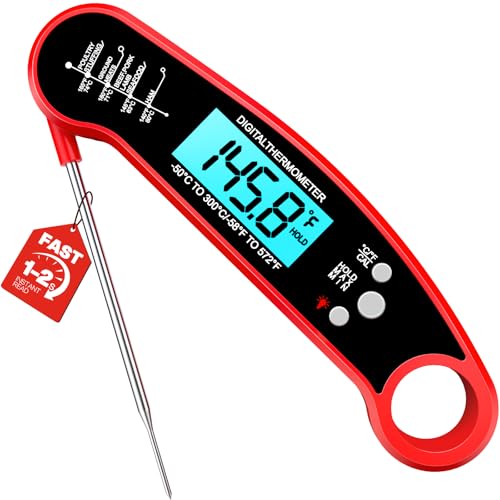
ONFIKY $9.99 Meat Thermometer: too new to trust?
A $9.99 backlit instant-read thermometer at 4.7 stars from 1,859 Amazon ratings. A cheap option that reviewers rate well, but it is a newer listing with less long-term feedback.
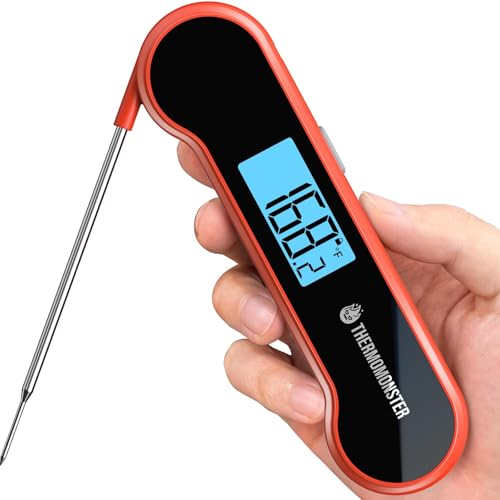
ThermoMonster 0.5-Sec Thermometer: maker's claims vs 8,323 reviews
A $14.99 instant-read thermometer with 4.8 stars from 8,323 Amazon ratings. Buyers praise quick, clear readings, and no big complaint has surfaced, but the track record is shorter.
Some links on this site are affiliate links. If you buy through them we may earn a small commission, at no extra cost to you.