Home › Guides › Plastic-free storage and meal prep
Best glass food storage containers: 8 things to check first
No ranked sets yet. Judge a glass set by glass type, lid, gasket, seal, stacking, freezer, oven limits and warranty; pick glass-and-silicone lids to reheat, bamboo for the fridge.
The best glass food storage containers have a borosilicate or properly tempered base, a lid rated for how you actually reheat, a gasket you can pull out and wash, and a warranty that covers the glass. Most sets get the glass right and the lid wrong. This guide walks through the eight checks that separate a good set from a disappointing one, then weighs glass, silicone and bamboo lids against each other.
We have not reviewed specific sets yet
Our product reviews so far cover cookware, air fryers, kettles and cutting boards, not glass storage sets. Until we have gone through individual sets the same way, this page stays a checklist rather than a ranking. Everything below comes from maker instructions and public sources. When the first container reviews go live, they will link from here.
Checks 1 and 2: glass type and lid material
1. Glass type. Two glasses show up in food containers. Borosilicate expands about one-third as much as ordinary soda-lime glass when heated and survives a temperature swing of roughly 330°F (166°C); soda-lime cracks at a swing of about 100°F (40°C), per Wikipedia's entry on borosilicate glass. The same source notes that much of the glass sold under the Pyrex name in the US since the 1940s has been soda-lime, not borosilicate.
Tempered soda-lime is not a defect; it resists chips and drops and it is what the big US brands sell. It just has rules: Anchor Hocking's care page says preheated oven only, up to 425°F, never freezer-to-oven, and never set a hot dish on a wet or cold surface. Pyrex's instructions, as quoted by Green Matters, match: preheat fully, stay under 425°F, cool on a potholder.
The listing should name the glass. "Borosilicate" is a maker's claim you cannot verify at home, but at least it is a claim. "Tempered glass" with no further detail means soda-lime; buy it and follow the thermal rules.
2. Lid material. The lid is the part that decides whether the set is plastic-free at all. Pyrex's Simply Store line closes with "BPA-free plastic lids" that are freezer, microwave and top-rack dishwasher safe (Pyrex). Its Freshlock lids are plastic with four locking tabs (Pyrex). Anchor Hocking's plastic lids are BPA-free and Prop 65 compliant (Anchor Hocking FAQ) but are "not intended for conventional oven, stovetop, broiler, or toaster oven use" (Anchor Hocking).
"BPA-free" is a narrow promise. A 2015 systematic review of 32 studies found the common substitutes BPS and BPF are as hormonally active as BPA (Rochester and Bolden, Environmental Health Perspectives). The FDA still considers BPA safe at the levels found in food, so this is an unsettled area; if you are pregnant or have a health condition, ask your doctor. The simpler route is to pick a lid that does not touch the food: glass, bamboo, or a silicone-rimmed glass lid, and do not fill the box to the rim. The three lid types are compared further down.
Checks 3 and 4: gasket and seal
3. Gasket: removable or molded in. Nearly every leak-resistant lid has a silicone ring. A ring you can pop out dries fully and does not trap sauce. Life Without Plastic says the silicone band on its bamboo lids is removable and that the lid and band must be hand washed and dried (Life Without Plastic). A molded-in gasket is tidier but you cannot clean under it. Check the product photos for a visible seam around the ring.
4. Airtight is not leakproof. Makers use the two words loosely. Airtight means the seal holds against air; leakproof means you can carry soup sideways. A lid with a gasket but no locking tabs or clips can be airtight while still leaking when tipped. If you commute with lunch, look for latching tabs and a gasket; if the box lives in the fridge, a drop-on glass or bamboo lid is enough. Glass lids with a silicone rim often add a vent and a pull tab to break the vacuum that forms as food cools (Seed & Sprout).
Checks 5 and 6: stacking and freezer
5. Stacking and nesting. Glass is heavy, so space matters twice: in the cabinet when empty and in the fridge when full. Sets with two or three footprints nest when empty. Flat-topped lids stack full containers without rocking. Rectangles pack tighter than rounds. None of this changes safety, but it decides whether the set gets used.
6. Freezer rules. Glass goes in the freezer with three habits. Cool food to room temperature before it goes in. Leave headspace, since liquids expand. And thaw before heating: Anchor Hocking says do not take a dish "directly from freezer to pre-heated oven or microwave" (Anchor Hocking). If you freeze soup in bricks, a plastic bin for the bottom layer is reasonable; the microplastic studies in our guide to glass vs plastic meal prep containers measured most of the shedding under heat, not in the cold.
Checks 7 and 8: heat limits and warranty
7. Oven and microwave limits. Oven: 425°F is the ceiling both Anchor Hocking and Pyrex publish, preheated, lid off. Microwave: glass bodies are fine; lids vary. Anchor Hocking says its covers can reheat for no longer than 60 seconds and need a gap for steam. Glass-and-silicone lids typically carry a lower rating than the base: one borosilicate set rates the body from -40°C to 250°C but the lid at 120°C (Seed & Sprout). Silicone itself melts above 220°C (428°F), according to Health Canada. Health Canada also notes that chemical transfer from plastics is most likely at high temperatures, such as when microwaving, which is the best reason to remove any plastic lid before reheating.
8. Warranty. A warranty tells you whether the maker expects the glass to survive. Pyrex storage sets carry a 2-year limited warranty (Pyrex). Anchor Hocking lists 5-year limited warranties on its Oven Basics line and food storage, and 10 years on its premium Fire-King line (Anchor Hocking FAQ). Read what it covers: breakage from oven heat is usually in; drops and ignored thermal rules are usually out.
Three lid types compared
Glass lid with a silicone rim. The only option where the lid face matches the base. Pros: no plastic on the food, no staining, the lid doubles as a plate. Cons: heavy, the silicone rim is rated far below the glass, and the lid still comes off for the oven. The Seed & Sprout set above is the pattern: body to 250°C, lid to 120°C, top rack for the seal.
Silicone lid or silicone-sealed plastic lid. Pros: flexible, light, usually the most leakproof, and silicone handles the microwave. Cons: a silicone-sealed plastic lid is still a plastic lid, with the BPA-substitute question above; a full silicone lid should stay below 428°F per Health Canada. Hand wash or top rack to keep the seal tight.
Bamboo lid. Pros: no plastic face, looks good on a counter, fine for pantry and fridge. Cons: it is a storage lid, not a cooking lid. The maker calls for hand washing and thorough drying of the lid and its silicone band, and a bamboo lid without latches is airtight but not leakproof when tipped (Life Without Plastic). Keep it out of the dishwasher and microwave.
Reheat in the box: glass-and-silicone, vented. Carry it: latching silicone-sealed lids, and accept the plastic. Fridge only: bamboo or plain glass, the least plastic of all.
Where this fits in a plastic-free kitchen
Containers are one drawer. Our guide to plastic-free kitchen swaps orders the rest by how much heat each item sees, which is why a glass electric kettle with no plastic touching the water and a titanium cutting board rank near the top. For fridge and freezer timing once the food is boxed, see how to store meal prep safely, and for what the "microwave-safe" stamp on plastic really means, see is it safe to microwave plastic.
Bottom line
Buy the glass for the base and judge the set by its lid. A tempered soda-lime body from a big brand with a 2- to 5-year warranty is fine as long as you respect the 425°F ceiling and skip freezer-to-oven moves. Pick the lid for the job: glass-and-silicone for reheating, latching silicone-sealed for carrying, bamboo for the fridge. Pull any plastic lid before the microwave. We will add ranked sets once we have reviewed them.
Sources
- Wikipedia: Borosilicate glass — accessed 2026-10-09
- Anchor Hocking: Care and use — accessed 2026-10-09
- Anchor Hocking: FAQs — accessed 2026-10-09
- Green Matters: Read this before using your Pyrex in the oven — accessed 2026-10-09
- Pyrex: Simply Store 4-piece round glass storage set — accessed 2026-10-09
- Pyrex: Freshlock 10-piece glass storage set — accessed 2026-10-09
- Rochester and Bolden, Environmental Health Perspectives 2015: Bisphenol S and F: a systematic review and comparison of the hormonal activity of bisphenol A substitutes — accessed 2026-10-09
- FDA: Bisphenol A (BPA): Use in food contact application — accessed 2026-10-09
- Life Without Plastic: Set of 3 small glass storage jars with a bamboo lid — accessed 2026-10-09
- Seed & Sprout: Glass food containers, rectangle (glass lid with silicone seal) — accessed 2026-10-09
- Health Canada: Safe use of cookware — accessed 2026-10-09
Products mentioned in this guide
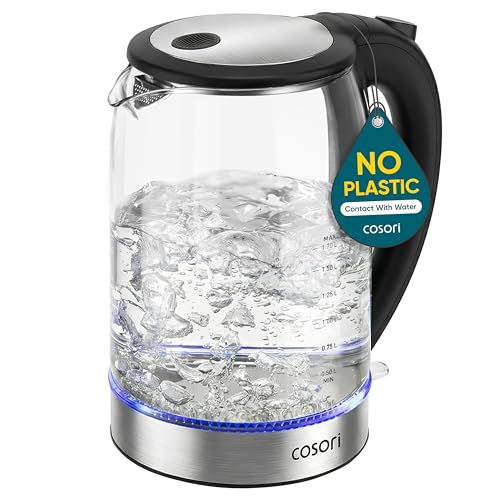
Cosori Glass Kettle: does water really never touch plastic?
A $24.43 borosilicate glass kettle that the maker says has no plastic touching the water. Heats fast and has 49,713 Amazon ratings, but durability is a clear concern.
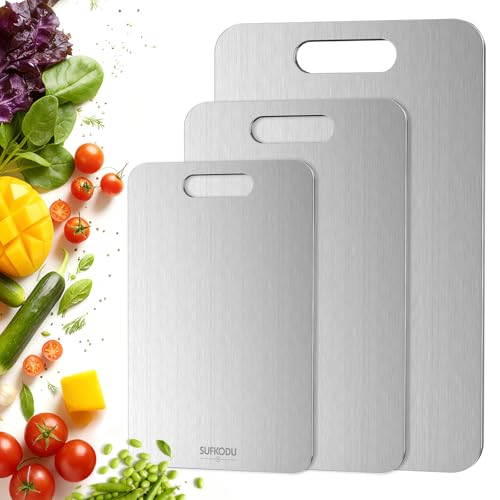
sufkodu Titanium Board Set: does titanium scratch? 988 reviews
A three-size titanium board set for $59.99 that buyers call well-made, light and easy to clean. It has under 1,000 ratings, the scratch reports are mixed, and the titanium claims come from the seller.
Some links on this site are affiliate links. If you buy through them we may earn a small commission, at no extra cost to you.