Home › Guides › Plastic-free storage and meal prep
Microplastics in tea bags, sponges, cutting boards: swap first?
Swap the plastic cutting board first (up to 50 g of microplastics a year), mesh tea bags second, the melamine sponge third. Free to about $60; no study shows harm in people.
Swap the plastic cutting board first, mesh tea bags second, and the melamine sponge third. That order follows the measured dose that lands in food: a plastic board can shed up to about 50 grams of microplastics a year straight onto what you chop; a plastic tea bag releases billions of particles into one cup, but only if the bag is plastic; a melamine sponge sheds millions of fibers per gram, most of which go down the drain. None of the three has been shown to harm people, and the World Health Organization's 2022 review says the data cannot yet settle that question either way. Here is what each study found, what to replace the item with, and roughly what it costs.
Why this order
Two questions decide the order: how much plastic gets into food, and how often. A cutting board is used daily and the particles fall directly onto food. A tea bag releases a lot per cup, but the fix is free and only matters for mesh bags. A sponge mostly contaminates rinse water, not dinner. This article is the hands-on part of our wider guide to microplastics in the kitchen, and it belongs to our plastic-free kitchen swaps series.
Swap 1: the plastic cutting board
The 2023 Environmental Science & Technology study by Yadav and colleagues chopped on polyethylene and polypropylene boards and modeled yearly exposure: 7.4 to 50.7 grams a year from polyethylene (14.5 to 71.9 million particles) and 49.5 grams from polypropylene (79.4 million particles). Polypropylene shed 5 to 60 percent more mass than polyethylene, and chopping carrots released more than chopping on an empty board (Yadav et al., Environmental Science & Technology 2023, abstract via Europe PMC). The same paper's preliminary test on mouse fibroblast cells found no drop in cell viability over 72 hours, which is the honest counterweight: large release, no harm shown in that test.
What to swap to:
- Titanium board. Hard, non-porous, dishwasher-friendly according to the makers. Two catches. "100% titanium" is a maker's claim that buyers on Amazon dispute for some brands, and knives scratch the surface; our titanium-versus-steel investigation walks through the evidence. The sufkodu Titanium Cutting Board Set of 3 is $59.99 on Amazon as of October 2026 (4.5 stars, 988 ratings; scratch reports mixed). The Mirtan Dual-Sided Titanium Cutting Board is $25.19 (4.6 stars, but only 155 ratings).
- Bamboo board. No "is it really metal" question, and cheaper. The Astercook Deep-Carbonized Bamboo Cutting Board Set of 3 is $24.99 (4.5 stars, 3,281 ratings); some buyers report cracking, and it is hand wash only.
What to keep: if you rely on the dishwasher to sanitize a raw-meat board, read our raw-meat cutting board guide before tossing the plastic one. A board you only use for bread is a low-friction, low-moisture job and sheds the least.
Cost: $25 to $60 one time. Care for the replacement is in our cutting board cleaning and oiling guide.
Swap 2: mesh tea bags
McGill University researchers steeped single plastic tea bags at brewing temperature and counted about 11.6 billion microplastics and 3.1 billion nanoplastics released into one cup. Water fleas exposed to the particles survived but showed anatomical and behavioral abnormalities. The lead researcher said more work is needed before anyone can say what, if anything, this does to people (McGill Newsroom, 2019, on Hernandez et al., Environmental Science & Technology).
Which bags count: the silky, see-through pyramid or mesh bags. Plain paper bags are not the subject of that study. Some paper bags are heat-sealed with a plastic layer; makers who have dropped it usually say "plastic-free" on the box, and that is a maker's claim you cannot check at home.
What to swap to:
- Loose leaf tea with a stainless steel infuser. No bag at all, and the tea is usually cheaper by the cup. This is the only swap on the list that can cost less than what it replaces.
- Paper bags labeled plastic-free. Fine if you want the convenience; treat the label as a claim.
- The water itself. Tea is hot water sitting in whatever the kettle is made of. The polypropylene baby-bottle study from Trinity College Dublin measured up to 16.2 million particles per liter when hot water met polypropylene, and polypropylene is the plastic in many kettle lids and windows (Food Packaging Forum on Li et al., Nature Food 2020). Our plastic-free kettle guide lists which parts touch the water. The Cosori 1.7L Stainless Steel Electric Kettle ($35.99, 4.5 stars, 5,486 ratings on Amazon as of October 2026) carries a "no plastic contact" maker's claim with a 304 stainless interior.
Cost: zero to the price of an infuser, plus the kettle if you go that far.
Swap 3: the melamine sponge
The 2024 Environmental Science & Technology paper by Su, Xing and Ji wore melamine foam sponges against textured metal and measured more than 6.5 million microplastic fibers per gram of sponge lost. Using one month of Amazon sales as a base, the authors put the global figure at 1.55 trillion fibers a month. Denser foam wore more slowly and shed fewer fibers (Open Access Government on Su, Xing and Ji, 2024).
Why it is third: the fibers are counted in rinse water, not in food. The study is about what goes down the drain. It still argues for not scrubbing plates and cups with a crumbling melamine block.
What to swap to:
- Cellulose sponge. Plant-based wood pulp, the old-fashioned kind. Check that it is not a cellulose face glued to a plastic scrub pad.
- Loofah or coconut-fiber scrubber. Plant fiber, compostable when done. Scrub power is lower on baked-on food.
- Cotton or linen dishcloth. Wash it with the laundry; no shedding question at all.
What to keep: if melamine is the only thing that lifts a scuff from a sink or stovetop, keep one for that job, buy the denser type, and retire it when it starts to crumble. Melamine foam is not the same material question as "bamboo" or melamine dishware, which is a chemical migration issue covered in our plastic-free kitchen swaps pillar.
Cost: the cheapest swap here. A cellulose sponge or dishcloth replaces a melamine block one for one.
What the numbers cannot tell you
Billions of particles sounds alarming, and it should be read next to the WHO's 2022 conclusion that "the limited data provide little evidence" of adverse effects in humans, with the data "of only very limited use" for risk assessment because labs count different particle sizes with different methods (Food Packaging Forum on the WHO 2022 report). Release has been measured; harm has not. If you have a health condition, ask your doctor before changing anything because of a study you read online.
Bottom line
Replace the plastic cutting board first: it sheds the most by weight and the particles land on food. Then drop mesh tea bags for loose leaf or paper, which costs nothing. Then switch the melamine sponge for cellulose or a dishcloth, mostly for the drain's sake. Together the three swaps run from free to about $60, and no study shows that any of them will make you healthier. They remove the three measured sources with the least effort, which is all they promise.
Sources
- Yadav et al., "Cutting Boards: An Overlooked Source of Microplastics in Human Food?", Environmental Science & Technology 2023 (abstract via Europe PMC) — accessed 2026-10-09
- McGill Newsroom: Some plastic with your tea? (Hernandez et al., ES&T 2019) — accessed 2026-10-09
- Food Packaging Forum: Study investigates microplastics release from baby bottles (Li et al., Nature Food 2020) — accessed 2026-10-09
- Open Access Government: melamine sponges and microplastic fibers (Su, Xing, Ji, ES&T 2024) — accessed 2026-10-09
- Food Packaging Forum: WHO report on potential human health implications of microplastics (2022) — accessed 2026-10-09
Products mentioned in this guide
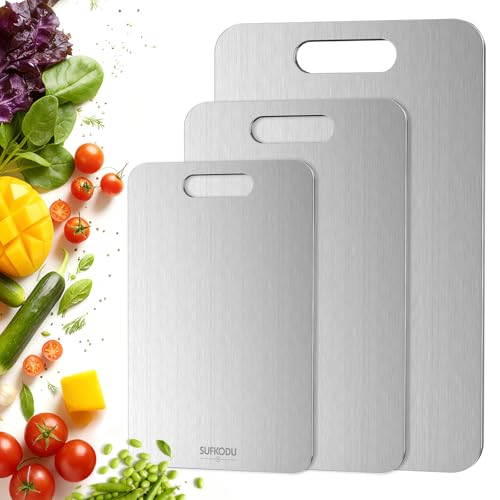
sufkodu Titanium Board Set: does titanium scratch? 988 reviews
A three-size titanium board set for $59.99 that buyers call well-made, light and easy to clean. It has under 1,000 ratings, the scratch reports are mixed, and the titanium claims come from the seller.
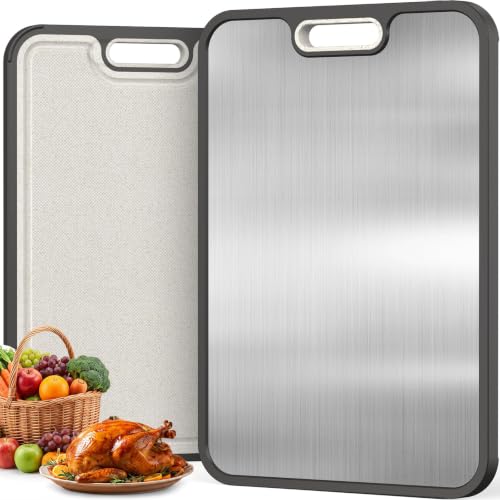
Mirtan Titanium Cutting Board: $25, 155 reviews, too new?
The cheapest board in this group at $25.19, with a titanium side for raw meat and a PP plastic side for produce. Early buyer feedback is positive, but it has only 155 ratings.
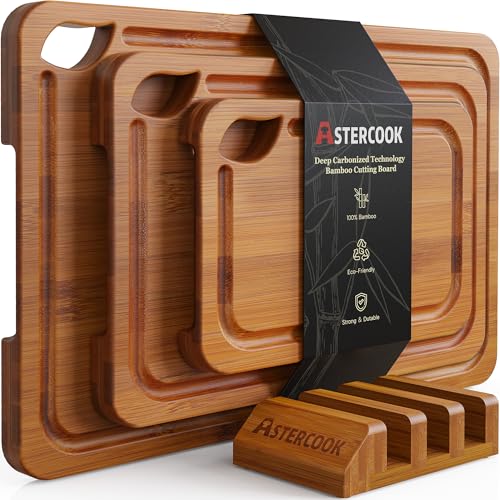
Astercook Bamboo Cutting Board Set: why some boards crack
A $24.99 bamboo set with three reversible boards and a stand. Buyers love the look and the gift appeal, but some report cracking and boards smaller than expected.
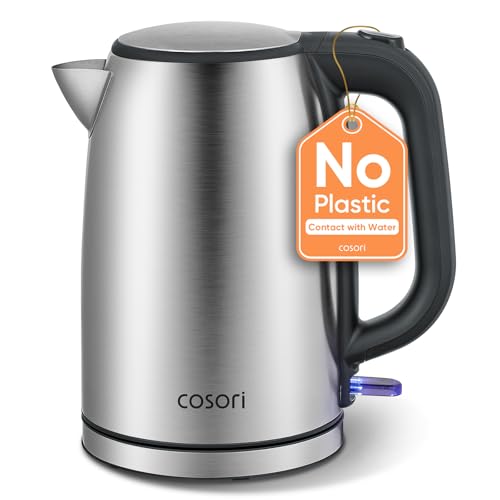
Cosori Stainless Steel Kettle: 304 steel inside, but does it last?
A $35.99 stainless steel kettle with a 304 stainless interior. Buyers praise speed and value, but some report it breaking after about 10 months.
Some links on this site are affiliate links. If you buy through them we may earn a small commission, at no extra cost to you.