Home › Guides › Buying guides
Non-toxic cutting boards for raw meat: 6 options ranked
Titanium or steel is easiest to sanitize but dulls knives; hardwood is best all-round with care; bamboo is cheap but cracks; glass is out. Always keep a separate board for produce.
For raw meat, the best non-toxic cutting board is one that does not soak up juices, survives hot water or a dishwasher after every use, and is used for meat only. Titanium or stainless steel passes the first two tests but dulls knives; solid hardwood is kind to knives but needs oiling and a prompt wash; bamboo is cheap and plastic-free but can crack. Plastic is easy to clean, with one catch: a 2023 study estimated that chopping on it sends grams of microplastic into food each year.
What a raw-meat board has to do
The rule that matters most has nothing to do with material. The FDA says to use "one cutting board for fresh produce and a separate one for raw meat, poultry, and seafood," and to wash boards "with hot soapy water after preparing each food item." The CDC adds bread and anything else that "won't be cooked" to the second board. Cross-contamination is the risk both agencies focus on; the material is not.
After that, four properties separate a good raw-meat board from a bad one:
- Low absorbency. Juices that sink into the surface are hard to wash out.
- Tolerance for hot water, bleach or a dishwasher. Extension offices recommend a sanitizing rinse of one tablespoon of unscented bleach per gallon of water, left on for several minutes, after raw meat (University of Wisconsin Extension). The board has to shrug that off.
- No deep grooves. Wisconsin Extension and Ohio State University Extension both say to discard a board once it develops hard-to-clean grooves, because they trap bacteria. A board that scars quickly has a short life on meat duty.
- Knife-friendliness, because a meat board sees a lot of slicing.
No material scores high on all four. The ranking below says which ones each misses.
Titanium and stainless steel: easiest to sanitize, hardest on knives
A sheet of metal absorbs nothing, does not crack, and takes bleach, boiling water and the dishwasher. I'm Plastic Free ranks titanium high for these reasons, noting its decades of use in medical devices and that it is "very easy to clean and to wash in a dishwasher."
The costs are real. Prudent Reviews measured knife edges with a sharpness tester after 600 cuts on each board: titanium cost 444 points of sharpness, stainless steel 184, end-grain walnut 15. America's Test Kitchen found metal boards dulled knives "dramatically," slid on the counter, scratched, and did not reduce bacteria any better than wood, plastic or bamboo washed in hot soapy water. Two of the five "titanium" boards it bought were plain stainless steel. A magnet that sticks hard means steel; our guide on whether titanium boards are real titanium or steel covers the weight test too.
Verdict for raw meat: the best sanitizing surface, if you accept extra sharpening and check what metal you got.
Solid hardwood: best for knives, needs discipline
Wood is the test kitchens' choice for everyday chopping. The Rational Kitchen notes that "wood harbors less bacteria than plastic, so is technically more hygienic," but that plastic "can go in the dishwasher, so it's easier to disinfect." That is the raw-meat trade-off in two sentences. Wisconsin Extension says solid wood boards can go through a dishwasher, while laminated or glued boards may crack; The Rational Kitchen still puts wood on the hand-wash list. Wood also needs oiling "monthly or at least a few times a year," per the same site, to avoid splitting, and a meat board that is washed hard and often needs the monthly end of that.
Verdict: a good raw-meat board if you scrub it right away, sanitize it, dry it upright and oil it. A poor one if it will sit in the sink.
Bamboo: cheap and plastic-free, but it cracks and chips edges
Bamboo is "harder and less porous than hardwoods," per Wisconsin Extension, which helps with juices. The Rational Kitchen adds that it is "hard on knife blades, some people think even harder than plastic." The Astercook Deep-Carbonized Bamboo Cutting Board Set ($24.99, 4.5 stars, 3,281 ratings on Amazon as of October 2026) is labeled hand wash only, and some buyers report boards cracking. I'm Plastic Free also warns that cheap bamboo boards are "thin strips glued together," so solid bamboo is preferable.
Verdict: a fair low-cost meat board if you wash and dry it right away and replace it when it cracks or grooves.
Glass: easy to clean, bad for everything else
Glass absorbs nothing and goes in the dishwasher, which is why it looks tempting for meat. The Rational Kitchen's advice is blunt: "Glass and marble are terrible for knives and should only be used for presentation." Skip it.
Plastic: the convenient standard, with a microplastics footnote
Plastic boards are cheap, light and dishwasher safe. The catch is a 2023 paper in Environmental Science & Technology (Yadav et al., PubMed 37220346): chopping on polyethylene boards was estimated to release 7.4 to 50.7 grams of microplastic per person per year, and polypropylene boards about 49.5 grams. The same study found no effect on the viability of mouse fibroblast cells from polyethylene particles over 72 hours, so it documents exposure, not harm. If you have a health condition and this worries you, ask your doctor. Our microplastics in the kitchen guide puts the number in context.
A "titanium" board with a plastic flip side is a plastic board when flipped; keep meat on the metal face.
The six boards we review, ranked for raw meat
Prices, stars and rating counts are from Amazon as of October 2026. Every titanium claim below is the maker's claim.
- GoodArtificer Titanium Cutting Boards, Set of 3 — $89.99, 4.6 stars, 250 ratings. Three metal sheets at a price closer to what real titanium costs. Minus: priciest of the group, and 250 ratings is a small sample.
- sufkodu Titanium Cutting Board Set of 3 — $59.99, 4.5 stars, 988 ratings. Double-sided set with the most reviews among the sets. Minus: still under 1,000 ratings, and scratch reports are mixed; if the second face is plastic, keep meat off it.
- Mirtan Titanium Cutting Board, Dual-Sided — $25.19, 4.6 stars, 155 ratings. Cheapest metal option. Minus: "100% pure titanium" at this price deserves the magnet test, and 155 ratings is too few to trust the average.
- Katori (Yiorr) Titanium Cutting Board Set of 3 — $59.75, 4.7 stars, 30 ratings. Minus: 30 ratings is a brand-new listing, and the maker itself says scratches are normal.
- Sumzzz Titanium Cutting Board, 16 x 11 — $38.99, 4.4 stars, 7,914 ratings. By far the most reviewed, which is why it ranks at all. Minus: buyers dispute the material, knives scratch it, and the second face is PP.
- Astercook Deep-Carbonized Bamboo Cutting Board Set — $24.99, 4.5 stars, 3,281 ratings. The only plastic-free, non-metal board here. Minus: hand wash only, some boards crack, and bamboo is hard on edges.
A solid maple or walnut board is not in our review list, but it is the board the test kitchens use, and the one to pick if you own good knives and will care for it.
How to run a two-board system
Pick one board for raw meat, poultry and seafood, and a different one, ideally a different color or material, for everything else. Wash the meat board in hot soapy water as soon as you finish, sanitize with diluted bleach or 5 percent vinegar (Ohio State Extension gives both), rinse, and dry it standing up. Retire it when it grooves. Our guide on how to clean and oil cutting boards has the ratios and the oiling routine; the plastic-free kitchen swaps guide covers what to change next. The same match-the-material-to-the-job logic runs through our best non-toxic pans ranking.
Bottom line
For raw meat, pick the board you will actually sanitize every time. Titanium or stainless is the easiest to keep clean and the worst for knives, so verify the metal and budget for sharpening. Hardwood is the better all-round board if you wash it right away and oil it monthly. Bamboo is the cheap plastic-free option with a cracking risk. Glass is out. Whichever you buy, the second board for produce matters more than the first.
Sources
- FDA, Safe Food Handling — accessed 2026-10-09
- CDC, Four Steps to Food Safety — accessed 2026-10-09
- University of Wisconsin Extension, "How Safe Is Your Cutting Board?" — accessed 2026-10-09
- Ohio State University Extension, Live Smart Ohio, cutting board safety — accessed 2026-10-09
- I'm Plastic Free, "Best Non-Toxic Cutting Boards (No Microplastics)" — accessed 2026-10-09
- Prudent Reviews, titanium and stainless steel cutting boards — accessed 2026-10-09
- America's Test Kitchen, metal cutting boards review — accessed 2026-10-09
- The Rational Kitchen, wood vs plastic cutting boards — accessed 2026-10-09
- Yadav et al., "Cutting Boards: An Overlooked Source of Microplastics in Human Food?", Environ. Sci. Technol. 2023, PubMed 37220346 — accessed 2026-10-09 (abstract read via Europe PMC record)
Products mentioned in this guide
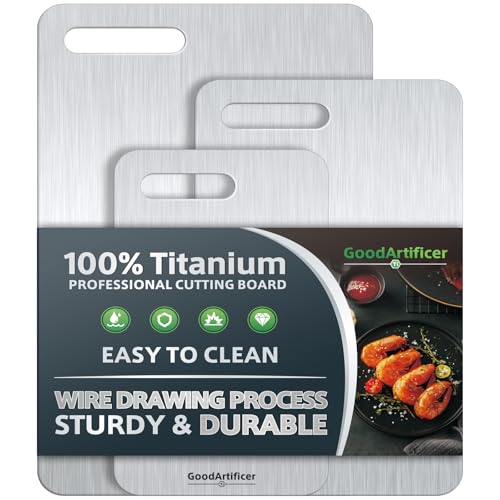
GoodArtificer Titanium Boards: worth $89.99 for three?
A three-board titanium set at $89.99, the priciest in this group. Buyers praise easy cleaning and the sizes, but it has only 250 ratings and the material claims are the seller's.
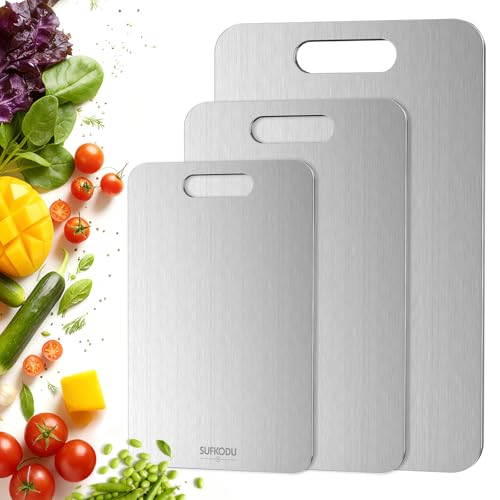
sufkodu Titanium Board Set: does titanium scratch? 988 reviews
A three-size titanium board set for $59.99 that buyers call well-made, light and easy to clean. It has under 1,000 ratings, the scratch reports are mixed, and the titanium claims come from the seller.
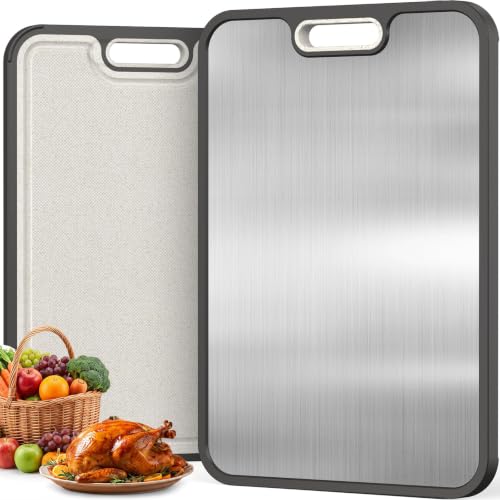
Mirtan Titanium Cutting Board: $25, 155 reviews, too new?
The cheapest board in this group at $25.19, with a titanium side for raw meat and a PP plastic side for produce. Early buyer feedback is positive, but it has only 155 ratings.

Katori Titanium Cutting Boards: 30 reviews, promising or unproven?
A new three-size titanium set at $59.75 with a 4.7-star rating, but only 30 ratings and no Amazon review summary yet. Treat it as promising but unproven.
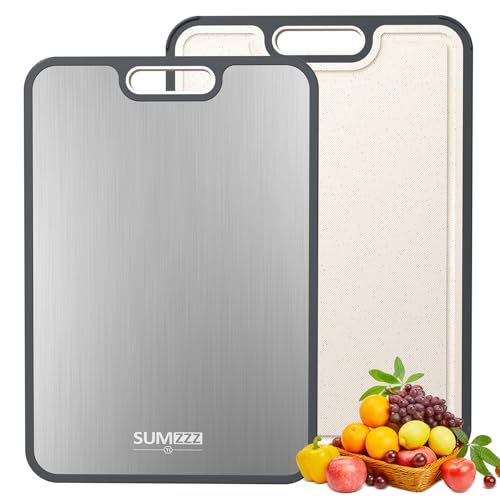
Sumzzz Titanium Cutting Board: is it really titanium?
A large two-sided board at $38.99, titanium on one side and PP plastic on the other. Buyers like the size and easy cleanup, but many dispute the titanium claim and some call it poor value.
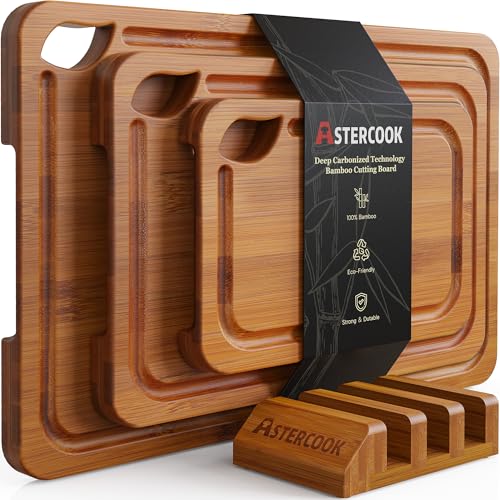
Astercook Bamboo Cutting Board Set: why some boards crack
A $24.99 bamboo set with three reversible boards and a stand. Buyers love the look and the gift appeal, but some report cracking and boards smaller than expected.
Some links on this site are affiliate links. If you buy through them we may earn a small commission, at no extra cost to you.