Home › Guides › Plastic-free storage and meal prep
Glass vs plastic meal prep containers: what the 2023 study found
Glass sheds no microplastics or bisphenols when reheated; plastic does. Most glass sets still use plastic or silicone lids, and US glass is usually soda-lime, so follow the thermal rules.
Glass keeps microplastics and plasticizers out of reheated food; plastic is lighter, cheaper and shrugs off drops. Peer-reviewed studies from 2020 and 2023 found that polypropylene containers shed millions to billions of plastic particles when heated, and glass does not. The catch is the lid: almost every glass set still closes with a plastic or silicone lid, so the swap is only as complete as the lid you pick and how you use it.
What the microwave studies measured
In 2023, researchers at the University of Nebraska-Lincoln microwaved two polypropylene baby food containers and one polyethylene pouch for three minutes at full power in a 1,000-watt oven. The plastic released more than 2 billion nanoplastics and 4 million microplastics per square centimeter, according to the University of Nebraska-Lincoln. The paper ran in Environmental Science & Technology. The same team stored containers for six months in the fridge and at room temperature and still found particles coming off, though far fewer than under microwave heat (Nebraska Engineering). When the team exposed cultured embryonic kidney cells to particle levels modeled on what a toddler might build up over days, about three-quarters of the cells died within two days. WebMD pointed out that the cells got far more particles than one reheating session releases, so that result is a warning sign, not a dose from your lunch.
A 2020 paper in Nature Food, summarized by the Food Packaging Forum, found polypropylene baby bottles released up to 16.2 million microplastic particles per liter during formula preparation, and the sterilizing and hot-water steps pushed the count up. Across 48 regions, formula-fed infants could take in 14,600 to 4.55 million particles a day. Those are infant products, not meal prep boxes, but polypropylene is also the plastic in most "microwave-safe" lunch containers.
Neither study shows what those particles do to an adult over years. That evidence does not exist yet. What the studies do show is that heat plus plastic equals shedding, and glass skips that step. Harvard Health says heating food in plastic raises the amount of chemicals that leach into it and advises against microwaving food in plastic containers. Health Canada says transfer from plastics is most likely at high temperatures, such as when microwaving.
"BPA-free" usually means BPS
BPA (bisphenol A) hardens polycarbonate plastic and lines some cans. The FDA still states BPA is safe at the levels found in food, while noting it ended BPA use in baby bottles and sippy cups in 2012 and in infant formula packaging in 2013 after manufacturers dropped those uses.
The replacements are the open question. A 2015 systematic review in Environmental Health Perspectives looked at 32 studies of bisphenol S (BPS) and bisphenol F (BPF), the usual stand-ins in "BPA-free" goods, and concluded both are as hormonally active as BPA (Rochester and Bolden, EHP). A Health Canada lab reported in 2016 that BPS triggered human fat cell formation in cell culture much like BPA did (Endocrine Society, via ScienceDaily). So a "BPA-free" sticker tells you one chemical is absent, not that the plastic is inert. Glass has no bisphenols to swap in or out. If you are pregnant or have a health condition, ask your doctor what exposure level matters for you; this research is still unsettled.
Borosilicate vs soda-lime: the thermal shock question
Two kinds of glass end up in food containers. Borosilicate glass has a thermal expansion coefficient roughly one-third that of ordinary soda-lime glass, and it can take a temperature swing of about 330°F (166°C) without cracking; soda-lime glass tolerates only about 100°F (40°C) (Wikipedia, Borosilicate glass). That is why a borosilicate lab beaker survives boiling water on ice and a soda-lime bowl does not.
Much of the glass sold under the Pyrex name in the US since the 1940s has been soda-lime, not borosilicate, per the same source. Tempered soda-lime is tough against chips and drops, but it still obeys the 100°F rule. That is why Anchor Hocking's care page says to use its glass only in a preheated oven up to 425°F, never go from freezer straight to a hot oven or microwave, and never set a hot dish on a wet or cold surface. Pyrex's instructions, quoted by Green Matters, say the same: preheat fully, stay at or below 425°F, and cool the dish on a potholder rather than a bare counter.
Makers rarely print "soda-lime" on the box. If a listing says "borosilicate," treat it as a maker's claim. If it says only "tempered glass," assume soda-lime and follow the thermal rules.
The lid problem
This is where the glass-vs-plastic argument gets honest. Walk down a store aisle and nearly every glass set closes with a plastic lid. Pyrex's Simply Store line uses "BPA-free plastic lids" rated for freezer, microwave and top-rack dishwasher (Pyrex); its Freshlock line uses plastic lids with four locking tabs (Pyrex). Anchor Hocking's lids are BPA-free plastic and "not intended for conventional oven, stovetop, broiler, or toaster oven use" (Anchor Hocking).
Even all-glass lids carry a silicone gasket, and the lid is rated far below the base. One borosilicate set lists the glass body at -40°C to 250°C but the glass-and-silicone lid at only 120°C, with the lid removed before the oven (Seed & Sprout). Bamboo lids also seal with a silicone band, and the maker says the lid and band must be hand washed and dried (Life Without Plastic).
The practical point: food sitting in the fridge mostly touches glass. The lid only matters when food reaches it (overfilled boxes, liquids, a tipped lunch bag) or when you microwave with the lid on. If you want nothing but glass touching hot food, pull the lid off before reheating and don't fill to the rim. Our guide to what to check in glass food storage containers compares glass, silicone and bamboo lids one by one.
Freezer and microwave with glass
Glass handles both, inside the rules above. For the freezer: let food cool to room temperature first, leave headspace for liquids to expand, and thaw before the oven or microwave, as Anchor Hocking instructs. For the microwave: reheat without the lid or with it vented; Anchor Hocking says its covers should reheat for no longer than 60 seconds and need a gap for steam. Glass bodies from the brands above are dishwasher safe; lids and gaskets go top-rack or by hand.
Plastic wins exactly one freezer point: it doesn't crack when dropped frozen. If your freezer is a chest of stacked bricks, a plastic bin on the bottom layer is a fair compromise, as long as it goes into the fridge to thaw, not into the microwave.
Weight, price and breakage
Glass is heavier, and five days of lunches in glass is real weight in a backpack. Glass also costs more per box, though the big brands back it: Pyrex storage carries a 2-year limited warranty (Pyrex) and Anchor Hocking food storage carries a 5-year limited warranty (Anchor Hocking FAQ). Plastic has no thermal shock rule and bounces off tile, but it stains, warps and holds odors. Pyrex says its glass "resists stains and does not absorb food odors or flavors."
Where the swap fits
If you are clearing plastic from the kitchen one drawer at a time, containers are the highest-value swap after anything that heats water or food, such as a glass electric kettle with no plastic touching the water or a titanium cutting board in place of a scarred plastic one. The full checklist is in our guide to plastic-free kitchen swaps. For fridge timing and reheating rules, read how to store meal prep safely; for what the "microwave-safe" label on plastic actually promises, read is it safe to microwave plastic; for the other particle sources in a kitchen, see microplastics in the kitchen.
Bottom line
Glass is the better material for anything you will reheat: no microplastic shedding under heat, no bisphenols, no absorbed odors. Buy it knowing three things. Most lids are plastic or silicone, so take the lid off before microwaving. Most US glass is tempered soda-lime, so no freezer-to-oven moves and no hot dish on a cold counter. And glass is heavy, so keep a plastic box or two for the freezer floor or the commute, and use them cold.
Sources
- University of Nebraska-Lincoln, Nebraska Today: Billions of nanoplastics released when microwaving baby food containers (Hussain et al., Environmental Science & Technology, 2023) — accessed 2026-10-09
- Nebraska Engineering: Nebraska engineers find billions of plastic particles released when microwaving containers — accessed 2026-10-09
- WebMD: Study says avoid microwaving plastic baby food containers — accessed 2026-10-09
- Food Packaging Forum: Study investigates microplastics release from baby bottles (Li et al., Nature Food, 2020) — accessed 2026-10-09
- Harvard Health: Microwaving food in plastic: dangerous or not? — accessed 2026-10-09
- Health Canada: Safe use of cookware — accessed 2026-10-09
- FDA: Bisphenol A (BPA): Use in food contact application — accessed 2026-10-09
- Rochester and Bolden, Environmental Health Perspectives 2015: Bisphenol S and F: a systematic review and comparison of the hormonal activity of bisphenol A substitutes — accessed 2026-10-09
- ScienceDaily / Endocrine Society: BPA substitute can trigger fat cell formation — accessed 2026-10-09
- Wikipedia: Borosilicate glass — accessed 2026-10-09
- Anchor Hocking: Care and use — accessed 2026-10-09
- Anchor Hocking: FAQs — accessed 2026-10-09
- Green Matters: Read this before using your Pyrex in the oven — accessed 2026-10-09
- Pyrex: Simply Store 4-piece round glass storage set — accessed 2026-10-09
- Pyrex: Freshlock 10-piece glass storage set — accessed 2026-10-09
- Seed & Sprout: Glass food containers, rectangle (glass lid with silicone seal) — accessed 2026-10-09
- Life Without Plastic: Set of 3 small glass storage jars with a bamboo lid — accessed 2026-10-09
Products mentioned in this guide
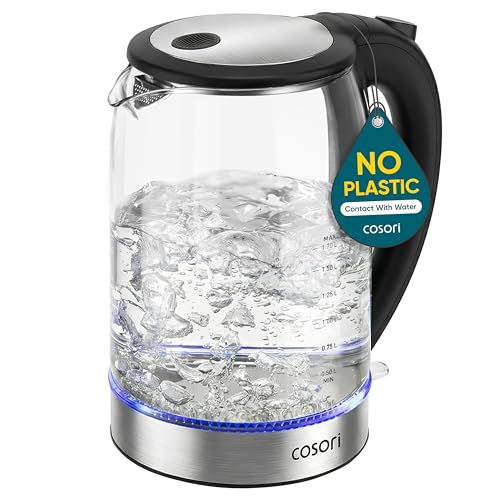
Cosori Glass Kettle: does water really never touch plastic?
A $24.43 borosilicate glass kettle that the maker says has no plastic touching the water. Heats fast and has 49,713 Amazon ratings, but durability is a clear concern.
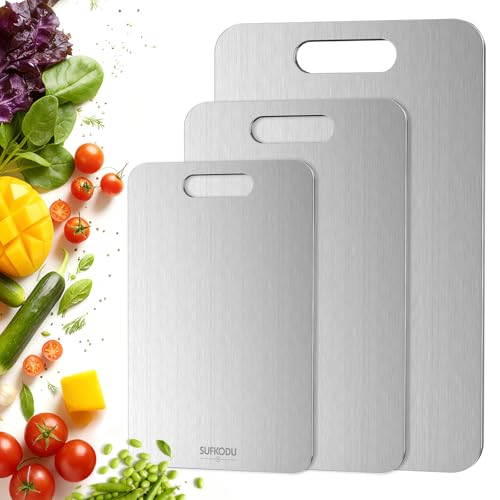
sufkodu Titanium Board Set: does titanium scratch? 988 reviews
A three-size titanium board set for $59.99 that buyers call well-made, light and easy to clean. It has under 1,000 ratings, the scratch reports are mixed, and the titanium claims come from the seller.
Some links on this site are affiliate links. If you buy through them we may earn a small commission, at no extra cost to you.